WhatsApp Business API vs SMS for Healthcare: Which One Should Actually Send Your Patient Messages?
- The WhatsApp Business API vs SMS for healthcare decision is not either/or. Most hospitals end up running both channels for different jobs.
- Neither SMS nor WhatsApp is HIPAA compliant by default. Meta does not sign a Business Associate Agreement for WhatsApp, and plain SMS has no built-in encryption.
- Peer-reviewed research shows appointment reminders reduce non-attendance meaningfully, regardless of which channel delivers them.
- Meta moved the WhatsApp Business Platform to per-message pricing on July 1, 2025, charging by template category and recipient country instead of by 24-hour conversation (Meta for Developers, 2026).
- In India, hospitals must register as a Principal Entity on TRAI’s DLT platform before sending any commercial SMS, a compliance step WhatsApp API does not require.
WhatsApp Business API vs SMS for healthcare is not a question with one universal answer.
It depends on which patient you are trying to reach, what you are sending them, and which regulator is watching. Hospital administrators are under real pressure to get this right now.
No-shows still cost outpatient clinics real revenue, and patients increasingly expect a reply inside the same app they already use to talk to family.
If you are already evaluating a WhatsApp Business API for Healthcare, you have probably also compared it against the SMS reminder system your front desk already runs.
This guide compares both channels on reach, engagement data, compliance, and cost, using primary sources instead of recycled marketing claims. By the end, you will know which messages belong on which channel, and why most hospitals end up running both.
See exact per-message costs before you commit budget to either channel.
Check WhatsApp Business API Pricing →What Hospitals Are Really Comparing When They Say “WhatsApp vs SMS”
“WhatsApp vs SMS” is shorthand for a bigger decision.
It is really a question of which channel handles which category of patient message, under which compliance rules, at what cost. Neither channel is inherently better.
They are built for different jobs.
WhatsApp Business API: a paid messaging platform, owned by Meta, that lets a verified business send pre-approved message templates to patients through the WhatsApp app, with two-way replies, media attachments, and automation built in.
SMS (Short Message Service): a text protocol that reaches any mobile phone number directly through the telecom network. No app and no internet connection is required at the recipient’s end.
WhatsApp Business API in One Paragraph
WhatsApp Business API connects to your hospital management system, EMR, or CRM.
It sends messages through templates that Meta reviews and categorizes as Marketing, Utility, or Authentication before they can be sent at scale (Meta for Developers, 2026).
Every message needs prior approval. That slows down changes, but it keeps quality and delivery high.
SMS and India’s DLT Layer, in One Paragraph
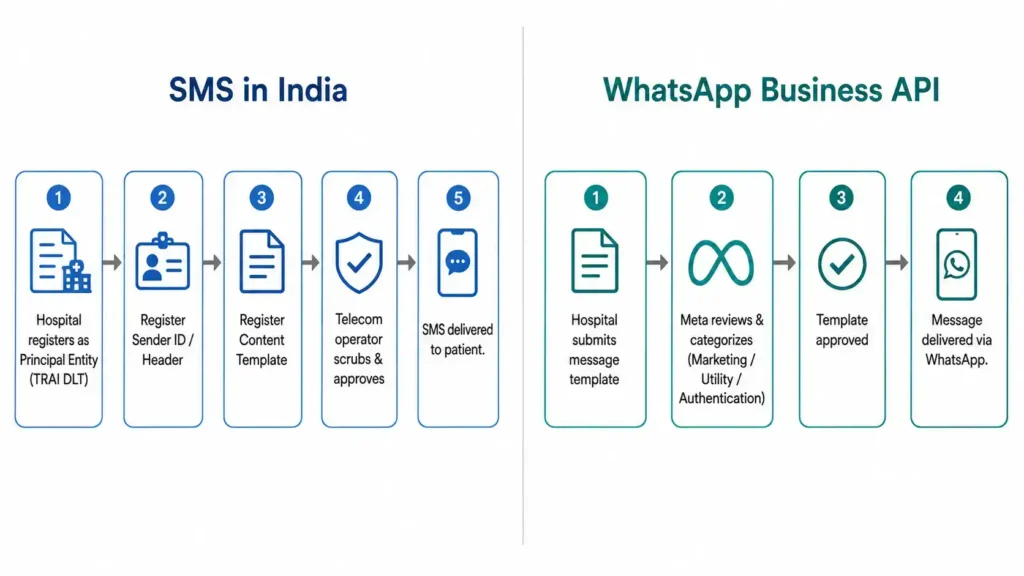
SMS needs no app and no data plan, which is why it still has the widest raw reach of any messaging channel.
In India specifically, this reach comes with its own approval layer.
TRAI requires any entity sending commercial SMS, hospitals included, to register as a Principal Entity on a DLT (Distributed Ledger Technology) platform and get its sender ID and message templates approved before sending (Telecom Regulatory Authority of India, 2026).
This is not a footnote. It is the SMS equivalent of Meta’s template review, run by a different regulator, and it is a step competing comparison articles rarely mention.
Reach: Where Each Channel Actually Lands on a Patient’s Phone
SMS reaches any device that can receive a call, including basic feature phones, with no app download and no internet connection required.
This makes it the only channel that guarantees delivery to every patient in your records, regardless of device or connectivity.
WhatsApp reach depends on whether the patient has the app installed and has data or Wi-Fi access when you send.
Meta’s last officially confirmed global user milestone was 2 billion monthly users, announced in February 2020, with continued growth described since but no new precise total published.
In practice, a hospital cannot assume 100% of its patient list is reachable on WhatsApp the way it can with SMS.
That is why most providers keep both channels active rather than replacing one with the other.
Open Rates and Response Rates: What the Data Actually Shows
This is the section where most competing articles quietly pick whichever number favors the channel they sell. We won’t do that.
A genuinely sourced, methodology-transparent “open rate” comparison between SMS and WhatsApp does not currently exist in public research.
Email open rates are measurable because of tracking pixels embedded in the message.
SMS has no equivalent tracking mechanism unless the carrier and device both support delivery reports, and WhatsApp’s own read-receipt data, the double blue checkmark, is not published by Meta as an aggregate industry statistic.
Every “98% WhatsApp open rate” or “95% SMS open rate” figure circulating online should be treated cautiously.
A 2026 WhatsApp benchmark by Chatarmin analyzed 13.9 million campaign messages from 382 brands and reported a 79% weighted read rate, measured as read messages divided by delivered messages.
The study provides a disclosed methodology and notes that the commonly cited 98% WhatsApp figure lacks a reliable source.
What we can say with confidence, and what actually matters for a hospital, is what happens after the message is opened.
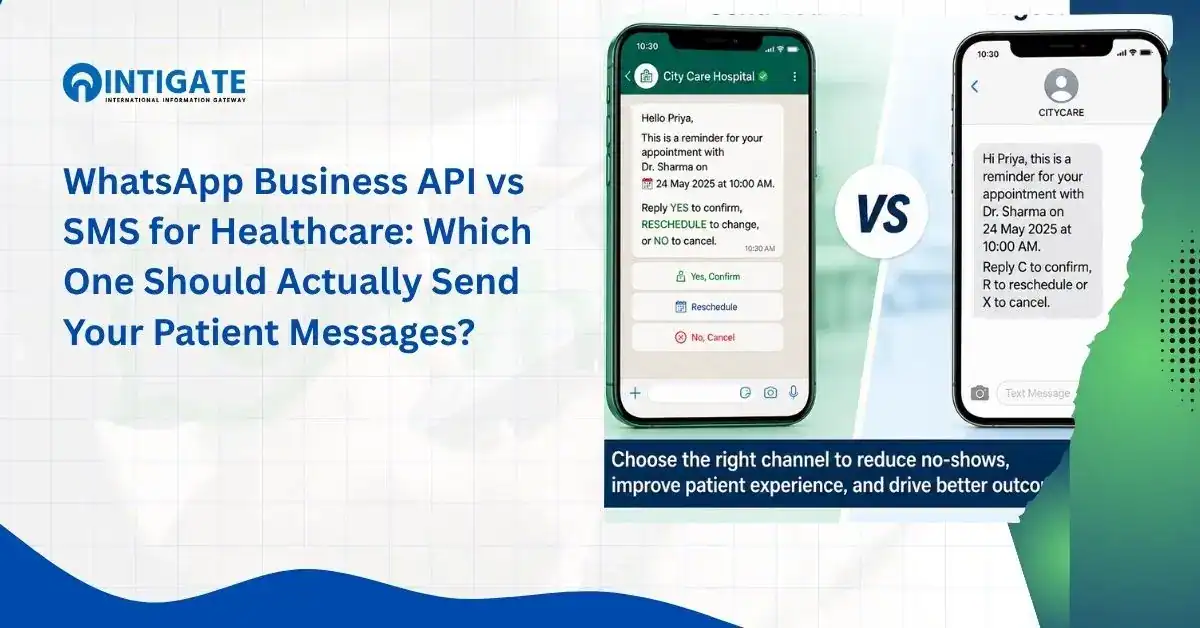
WhatsApp supports two-way replies and interactive buttons inside a single thread, letting a patient confirm or reschedule an appointment without typing a reply.
Standard SMS is largely one-way unless paired with a specific keyword-reply system.
This structural difference in interactivity, not an unverifiable open-rate percentage, is the real basis for comparing the two channels on engagement.
Impact on No-Shows: What the Peer-Reviewed Research Says
Appointment reminders work, and this part of the debate has actual peer-reviewed evidence behind it rather than vendor claims.
A systematic review of reminder interventions for hospital outpatient appointments found that reminders produced a weighted mean relative reduction in non-attendance of 34% compared to sending no reminder at all, based on synthesized data across multiple studies.
A separate randomized controlled trial ran across 14 hospitals in Israel.
It involved more than 161,000 scheduled outpatient appointments and tested different message framings.
The best-performing message reduced the no-show rate from 21.1% in the control group to 14.2%.
An earlier observational study in a London ophthalmology outpatient department found that SMS reminders reduced the non-attendance rate from 18.1% to 11.2%, an absolute reduction of 6.9 percentage points.
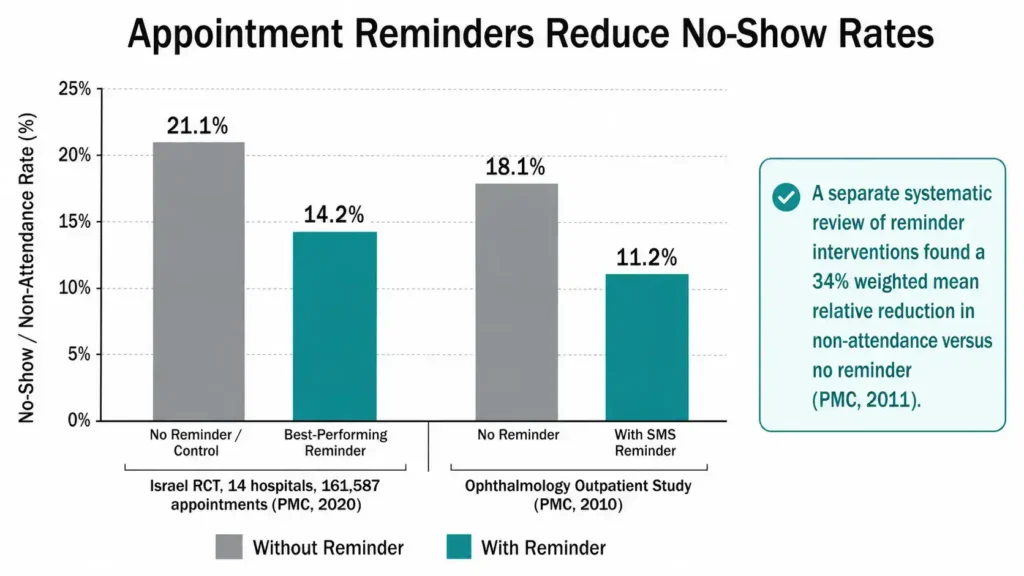
Two things stand out across this research.
First, the reminder itself appears to drive most of the benefit, rather than the specific channel used.
Second, the available studies do not provide a controlled, head-to-head comparison of SMS and WhatsApp for reducing no-shows.
Therefore, the claim that “WhatsApp reduces no-shows more than SMS” is not currently supported by peer-reviewed evidence.
The Compliance Question Nobody Answers the Same Way Twice
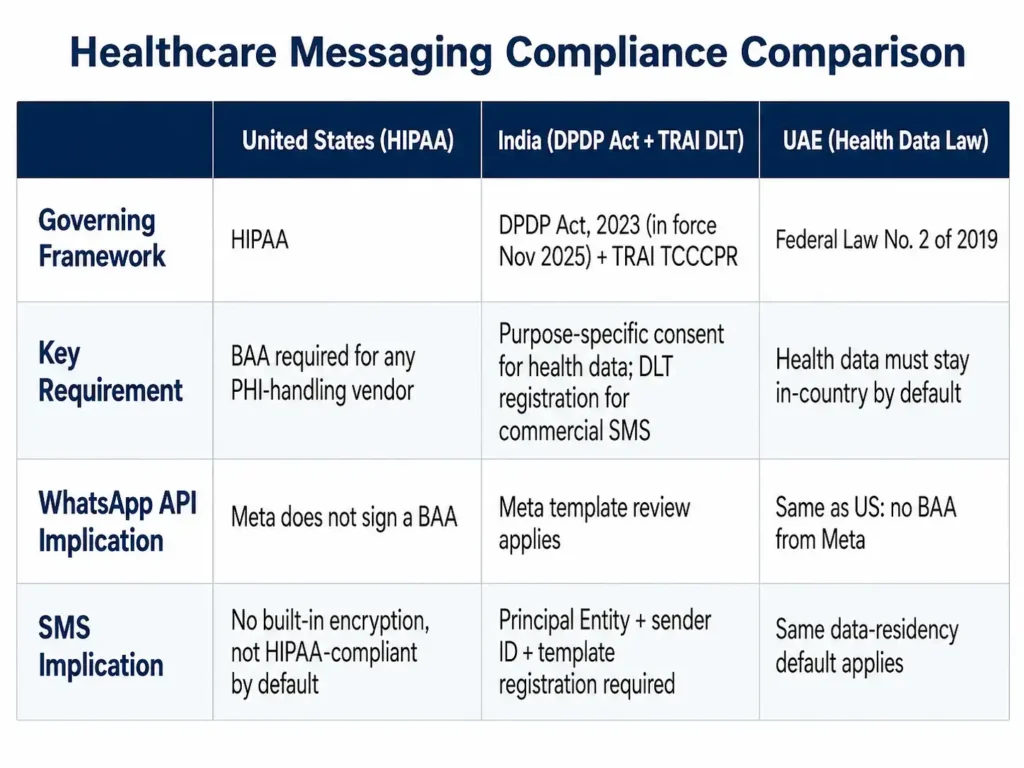
This is the section where accuracy matters more than persuasion, so we are going to be direct about what each regulation actually requires.
Business Associate Agreement (BAA): a written contract required under HIPAA between a covered healthcare entity and any vendor that creates, receives, or transmits protected health information (PHI) on its behalf (HHS.gov, 2024).
United States: HIPAA and the Missing BAA
Under HIPAA, any vendor handling PHI on behalf of a covered entity must sign a BAA (U.S. Department of Health and Human Services, 2024).
Meta does not offer a BAA for WhatsApp.
Standard SMS also carries no encryption by default and is not HIPAA compliant on its own.
In practice, a U.S. hospital cannot legally rely on either standard WhatsApp or standard carrier SMS to transmit clinical detail.
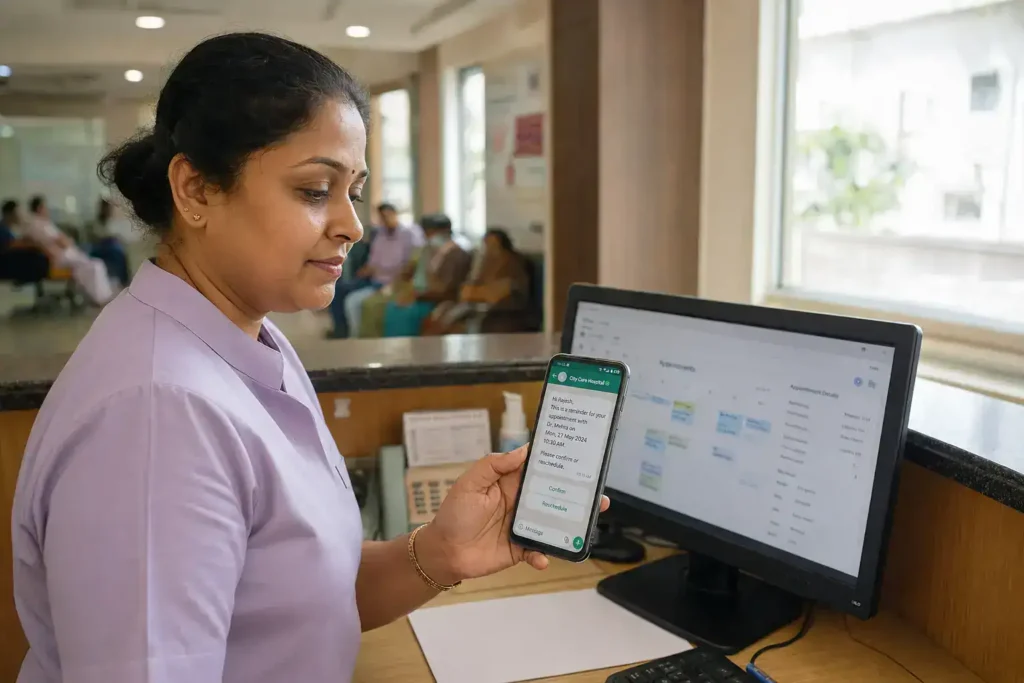
Both channels can still be used for logistics, appointment times, and redirect-to-portal notifications, as long as no PHI appears in the message body itself.
For a fuller breakdown, see our guide on WhatsApp Business API for HIPAA-compliant messaging.
India: DPDP Act and TRAI DLT, the Layer Competitors Skip
India’s Digital Personal Data Protection Act, 2023 received presidential assent on August 11, 2023.
The Ministry of Electronics and Information Technology notified the accompanying DPDP Rules on November 13, 2025.
That notification is often described as the Act “coming into force,” but it is more precise to say it activated only the first of three phases: the Data Protection Board and foundational definitions.
Consent-manager provisions follow twelve months later, in November 2026, and the substantive compliance obligations that actually govern consent notices and purpose limitation take effect eighteen months out, around May 13, 2027 (Ministry of Electronics and Information Technology, Government of India, 2025).
That phased timeline does not mean hospitals can wait.
Health data qualifies as sensitive personal data once the substantive rules land, and a blanket “I agree to receive messages” checkbox is unlikely to satisfy the purpose-specific consent standard the rules describe.
Building compliant consent capture now, ahead of the 2027 deadline, is the safer position for any hospital scaling patient messaging today.
Separately, and specifically for SMS, TRAI requires every business sending commercial SMS in India, hospitals included, to register as a Principal Entity on an operator DLT platform and pre-register its sender ID and content templates before sending (Telecom Regulatory Authority of India, 2026).
This is a real operational step, not a talking point. It applies regardless of whether the SMS is transactional or promotional.
GCC: UAE, Qatar, and Kuwait Health Data Rules
In the UAE, Federal Law No. 2 of 2019 on the use of information and communications technology in health fields is known as the Health Data Law.
By default, it requires electronic health data to be stored inside the UAE. It restricts transferring that data outside the country unless a specific exemption applies.
Ministerial Resolution 51 of 2021 later created ten defined exception categories, such as telemedicine and pharmacovigilance reporting, that can be approved case by case.
Qatar and Kuwait each maintain their own health data and data protection frameworks.
Confirm requirements against your specific facility’s license and jurisdiction before any patient data flows through a third-party messaging platform.
This is a general overview and not legal advice. Confirm your specific obligations with your compliance team before finalizing a template set.
Cost Comparison: What WhatsApp API and SMS Actually Cost a Hospital in 2026
Meta changed how WhatsApp Business Platform pricing works fairly recently, and a lot of published cost comparisons still describe the old model.
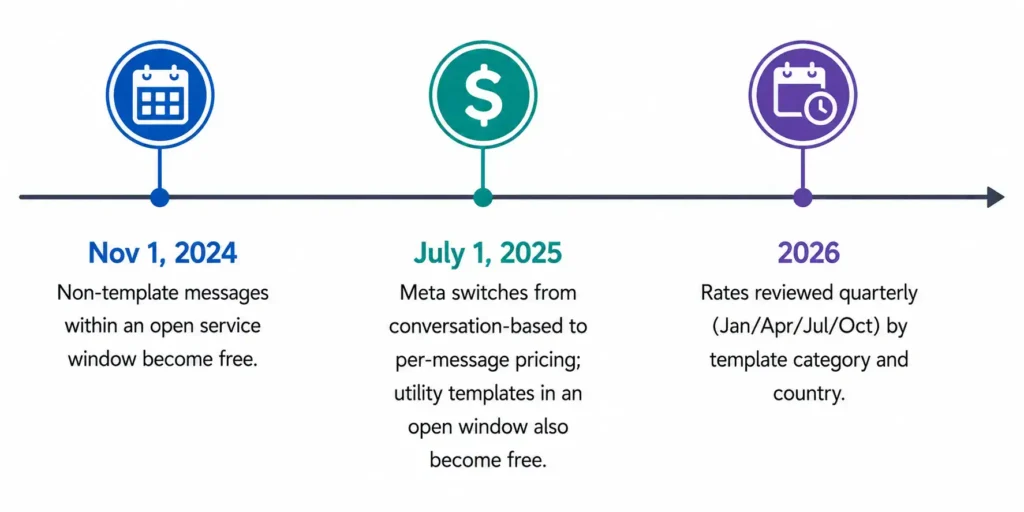
Effective July 1, 2025, Meta moved from conversation-based pricing to per-message pricing. Businesses are now charged per delivered template message.
The rate depends on the template’s category, Marketing, Utility, or Authentication, and on the recipient’s country calling code, rather than on a flat 24-hour conversation fee.
Non-template messages sent within an open 24-hour customer service window have been free since November 1, 2024.
Utility template messages sent within that same open window have been free since July 1, 2025.
Meta also offers volume-based tiers that unlock lower utility and authentication rates as monthly message volume increases, and rates are reviewed on a quarterly calendar (Meta for Developers, 2026).
Meta has also announced further pricing structure changes for Business Agent, service, and utility messages effective August 1 and October 1, 2026, so confirm the live rate card at setup rather than relying on any published snapshot, including this one.
Per-Message SMS Cost in India, Plus DLT Overhead
SMS pricing in India is set by individual telecom-authorized aggregators rather than by a single public rate card, and it varies by route, volume, and provider.
What is fixed and worth budgeting for separately is the one-time DLT compliance overhead: TRAI-mandated Principal Entity, sender ID, and template registration, which most aggregators quote as a flat setup fee before any message can legally be sent (Telecom Regulatory Authority of India, 2026).
Per-Conversation WhatsApp API Cost, Now Per-Message
Because rates vary by country and are updated multiple times a year on Meta’s own pricing calendar, we are intentionally not printing a specific rupee figure here that could be stale within a quarter — as of publication, Meta’s India Utility and Authentication rate stands at approximately ₹0.115 per message.
The reliable way to budget is to check Meta’s official rate card at the time of setup, then add your chosen Business Solution Provider’s markup on top.
Meta’s published rate is a wholesale rate, not the final invoice most hospitals pay.
What Each Channel Is Actually Good At in a Hospital Workflow
When SMS Still Wins
SMS remains the safer default for anything that must reach every patient regardless of device, app installation, or data plan:
- One-time passwords and identity verification for patient portals.
- Time-critical alerts where guaranteed delivery matters more than rich formatting.
- Reaching patients on older or feature phones, particularly in rural or older-adult populations.
When WhatsApp Business API Wins
WhatsApp is the stronger fit when the message benefits from a reply, a document, or an ongoing thread:
- Appointment confirmations where a one-tap “Confirm” or “Reschedule” button replaces a phone call.
- Report-ready notifications that redirect the patient to a secure portal instead of stating results in the message.
- Post-visit engagement, such as feedback requests and preventive-care check-ins, that benefit from a two-way conversation.
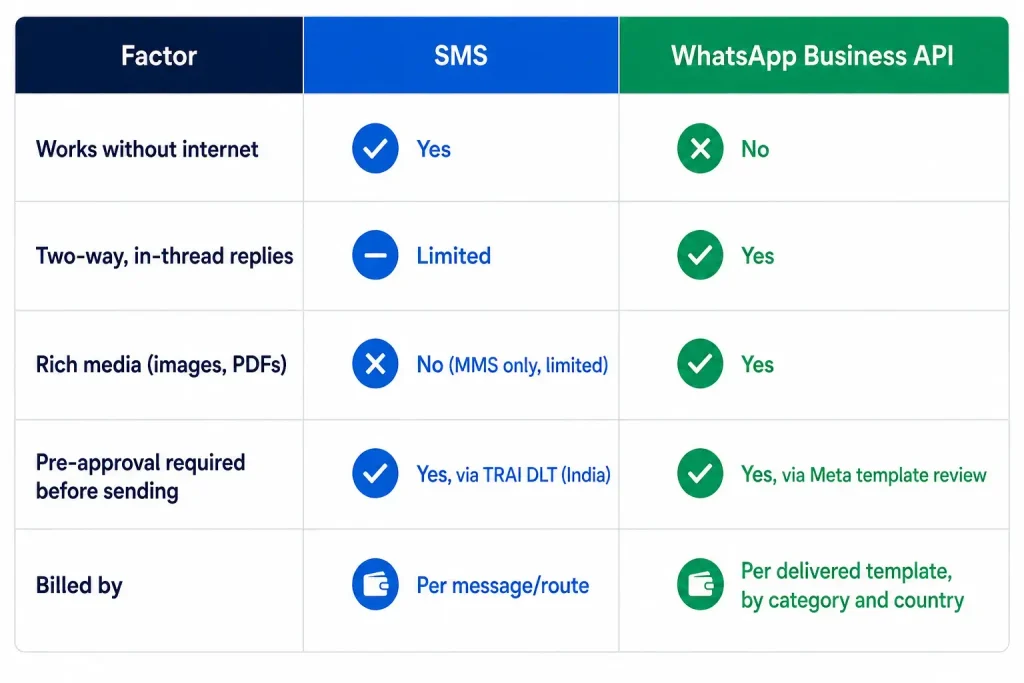
| Factor | SMS | WhatsApp Business API |
|---|---|---|
| Works without internet | Yes | No |
| Two-way, in-thread replies | Limited | Yes |
| Rich media (images, PDFs) | No (MMS only, limited) | Yes |
| Pre-approval required before sending | Yes, via TRAI DLT (India) | Yes, via Meta template review |
| Billed by | Per message/route | Per delivered template, by category and country |
Why Most Hospitals End Up Running Both, Not Choosing One
The research above points to a consistent conclusion: reach and interactivity are different strengths.
A hospital that needs both ends up running SMS and WhatsApp side by side rather than replacing one with the other.
SMS acts as the guaranteed-delivery layer for OTPs and time-critical alerts.
WhatsApp becomes the engagement layer for anything that benefits from a reply, a document, or an ongoing conversation.
This mirrors how WhatsApp Business API for Healthcare deployments are typically scoped in practice, as an addition to existing SMS infrastructure rather than a wholesale replacement of it.
Where WhatsApp Business API Fits With Your CRM, EMR, or HMS
A common but flawed framing of this decision is “WhatsApp API vs healthcare CRM,” as if the two compete for the same job. They do not.
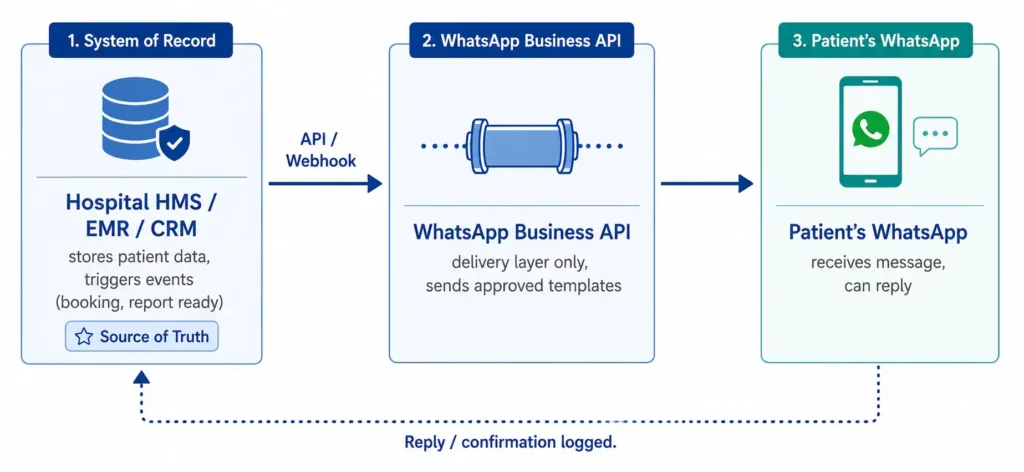
WhatsApp Business API is a messaging channel. Your CRM, EMR, or hospital management system is the system of record that stores patient data and triggers messages.
The API connects to that system through standard API and webhook integrations, so a booking confirmation or report-ready alert fires automatically from an event inside your existing software, rather than replacing that software.
In practice, WhatsApp Business API sits alongside your CRM and EMR as a delivery layer, similar to how WhatsApp Chatbot for Hospitals use cases are typically built on top of an existing booking or ticketing system rather than as a standalone replacement for it.
Choosing a WhatsApp API Provider for Healthcare, Once You Have Decided to Add It
Once a hospital decides WhatsApp Business API is worth adding alongside SMS, the provider decision comes down to a small number of criteria that actually matter once you are live, and a template gets rejected on a busy day:
- Official Meta Business Partner status. Direct standing with Meta rather than a reseller of a reseller.
- Real healthcare template approval experience. Providers who have gotten clinical-adjacent templates approved before, not just generic marketing templates.
- Presence in your operating market. Regulatory and language support specific to where your patients actually are.
- Integration support for your existing HMS, EMR, or CRM. Connected properly at setup, not bolted on afterward.
- A responsive point of contact when a template gets paused. Meta’s automated enforcement affects every account eventually. What matters is how fast you get a resolution.
See our full comparison of WhatsApp API providers for healthcare if you want to evaluate options side by side.
Get your appointment, reporting, and follow-up workflows mapped onto a healthcare-ready template library before you send a single message.
Book a Free Consultation →Conclusion
WhatsApp Business API vs SMS for healthcare is not a contest with a single winner.
SMS remains the only channel that guarantees delivery to every patient regardless of device or connectivity, which keeps it essential for OTPs and time-critical alerts.
WhatsApp Business API earns its place through two-way replies, richer report and document delivery, and ongoing patient engagement, provided your templates and consent workflows are built around the compliance realities of HIPAA, India’s DPDP Act and TRAI DLT rules, or your specific GCC jurisdiction.
The peer-reviewed evidence is clear that reminders themselves reduce no-shows meaningfully.
The channel you send them on should be chosen based on reach, compliance, and workflow fit, not on whichever open-rate statistic a vendor is promoting that quarter.
For most hospitals, that means running both.
Frequently Asked Questions
Is WhatsApp Business API HIPAA compliant?
Not by default. Meta does not sign a Business Associate Agreement for any WhatsApp product, and a BAA is required before a platform can legally transmit protected health information under HIPAA. WhatsApp Business API works for appointment logistics and non-clinical updates, but clinical detail should stay off the channel for U.S. covered entities.
Can hospitals send lab reports or prescriptions over WhatsApp legally?
You can notify a patient that a report is ready without including clinical content in the message itself. A short template that redirects the patient to a secure portal, or asks them to call the clinic, keeps the message out of protected-health-information territory while still using WhatsApp’s speed.
Should a hospital replace SMS with WhatsApp Business API?
Generally, no. SMS still reaches patients without internet access or a WhatsApp account, which WhatsApp cannot guarantee. Most hospitals run both, using SMS for OTPs and universal-reach alerts and WhatsApp for two-way, interactive patient communication.
Does WhatsApp Business API replace our CRM or EMR?
No. WhatsApp Business API is a messaging channel that connects to your existing CRM, EMR, or hospital management system through APIs and webhooks. It sends and receives messages triggered by events in that system. It does not store patient records or replace the system itself.