
WhatsApp Business API for Healthcare
Send appointment reminders, report alerts, and follow-ups on the app your patients already check every day, without gambling your compliance on a platform that was never built to carry patient data. Intigate designs healthcare WhatsApp messaging the way it should actually be built: fast to roll out, honest about its limits.
What WhatsApp Business API for Healthcare Actually Is
The free WhatsApp Business app works fine for a single front desk phone answering a handful of chats a day. It was never built for a hospital sending thousands of appointment reminders, report alerts, and follow-ups a week.
WhatsApp Business API is Meta's enterprise messaging layer. It connects directly to your hospital management system, EMR, or CRM, sends pre-approved message templates at scale, and gives you a Meta-verified sender identity patients recognize and trust. As an Official Meta Business Partner, Intigate handles the setup, template approval, and ongoing account health so your team can focus on patients instead of API documentation.
Meta-verified sender
Patients see your clinic's verified name, not an unknown number.
Template-based messaging
Every message is pre-approved by Meta, which is what keeps quality and delivery high.
Built for scale
From a single clinic to a multi-branch hospital group, without changing platforms.
Meta Business Partner setup
We handle verification and template approval so you don't have to.
Four Ways Hospitals and Clinics Use WhatsApp Business API
Not a feature dump. These are the use cases that consistently free up front-desk time and keep patients engaged between visits.
Appointment Lifecycle
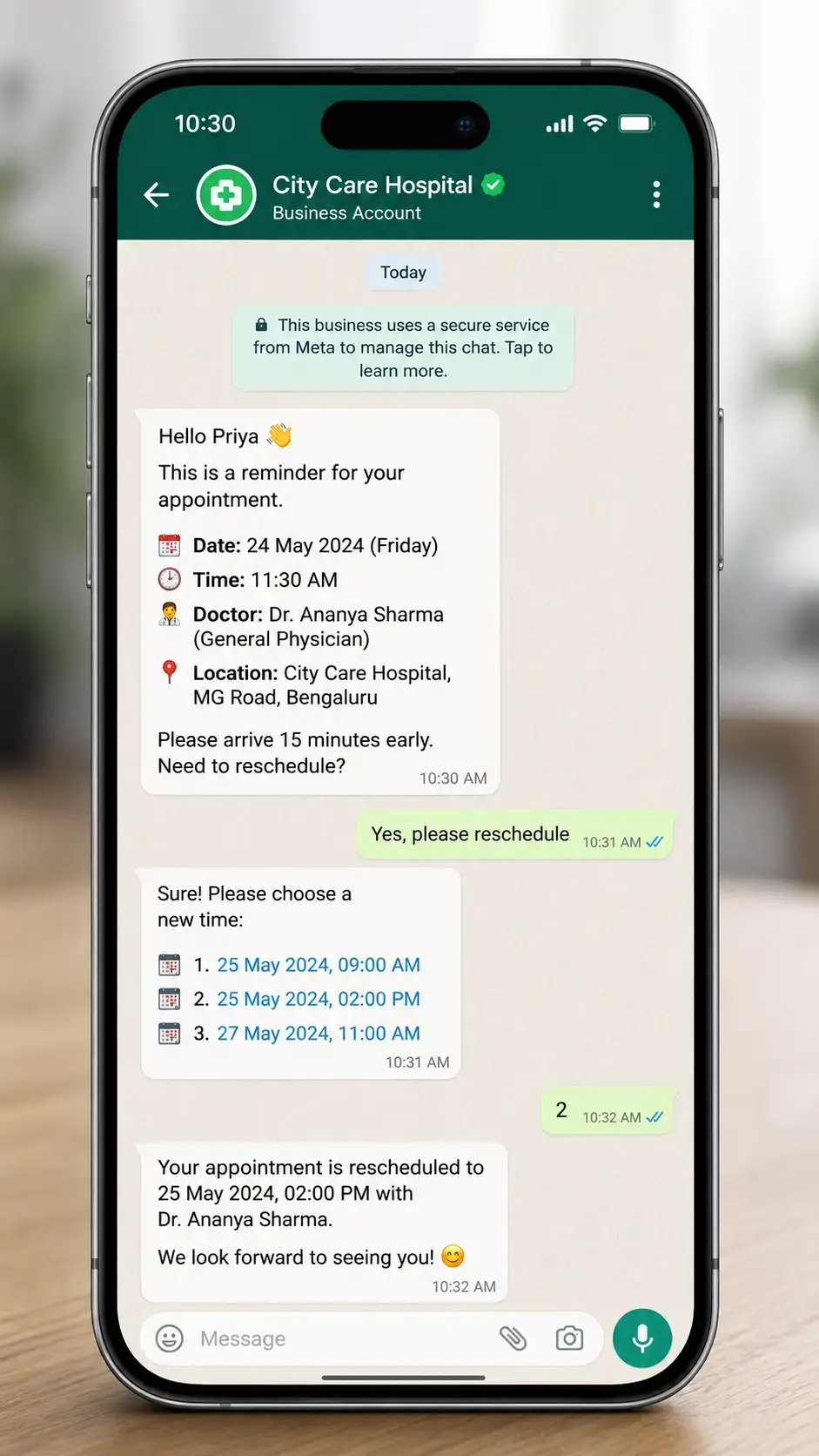
Booking confirmations, 24-hour reminders, and one-tap reschedule or cancel, all inside the chat. Patients respond with a tap instead of calling your front desk, and your team sees the update in real time.
Report & Document Alerts
Let patients know a report is ready without putting the result in the message. A short "your report is ready, view it in your portal" template gets the same open rate without the compliance exposure. More on how this works below.
Patient Engagement & Retention
Post-visit check-ins, preventive care reminders, and feedback requests that keep patients connected between visits, not just during them. This is where WhatsApp quietly pays for itself in repeat visits.
Front-Desk Deflection
Automated answers for OPD timings, doctor availability, directions, and insurance basics. Routine questions get answered instantly, so your staff's calls are the ones that actually need a person.
The Compliance Question Most Vendors Won't Answer Straight
Search around and you'll see plenty of WhatsApp API providers advertise "HIPAA-compliant messaging." That claim doesn't hold up: Meta does not sign a Business Associate Agreement for any WhatsApp product, and a BAA is required before a platform can legally carry Protected Health Information under HIPAA. We'd rather tell you that on this page than have you find out during an audit.
United States: HIPAA
No BAA is available from Meta for any WhatsApp product. Use WhatsApp for logistics, not clinical detail, unless a patient has specifically requested it as their preferred confidential channel.
India: DPDP Act
Health data is treated as sensitive personal data. Explicit, documented, purpose-specific consent is required. A blanket "I agree to receive messages" checkbox is not enough on its own.
GCC: Health Data Regulations
UAE, Qatar, and Kuwait each have their own health data and cross-border transfer rules (in the UAE, this includes the Health Data Law and DHA policy). Requirements vary by jurisdiction and should be checked against your specific license.
This is a general overview, not legal advice. We help you design compliant templates and consent workflows; your legal or compliance team should confirm the final setup against your specific obligations.
Built to Send the Right Message, the Right Way
Meta sorts every WhatsApp template into Utility, Marketing, or Authentication. Healthcare messages almost always belong in Utility, and the safest ones never put clinical detail in the message body at all. Here's the pattern we use.
Same open rate, same urgency, none of the clinical detail sitting in a message thread outside your systems. This "notify and redirect" pattern is the backbone of most compliant healthcare template libraries.
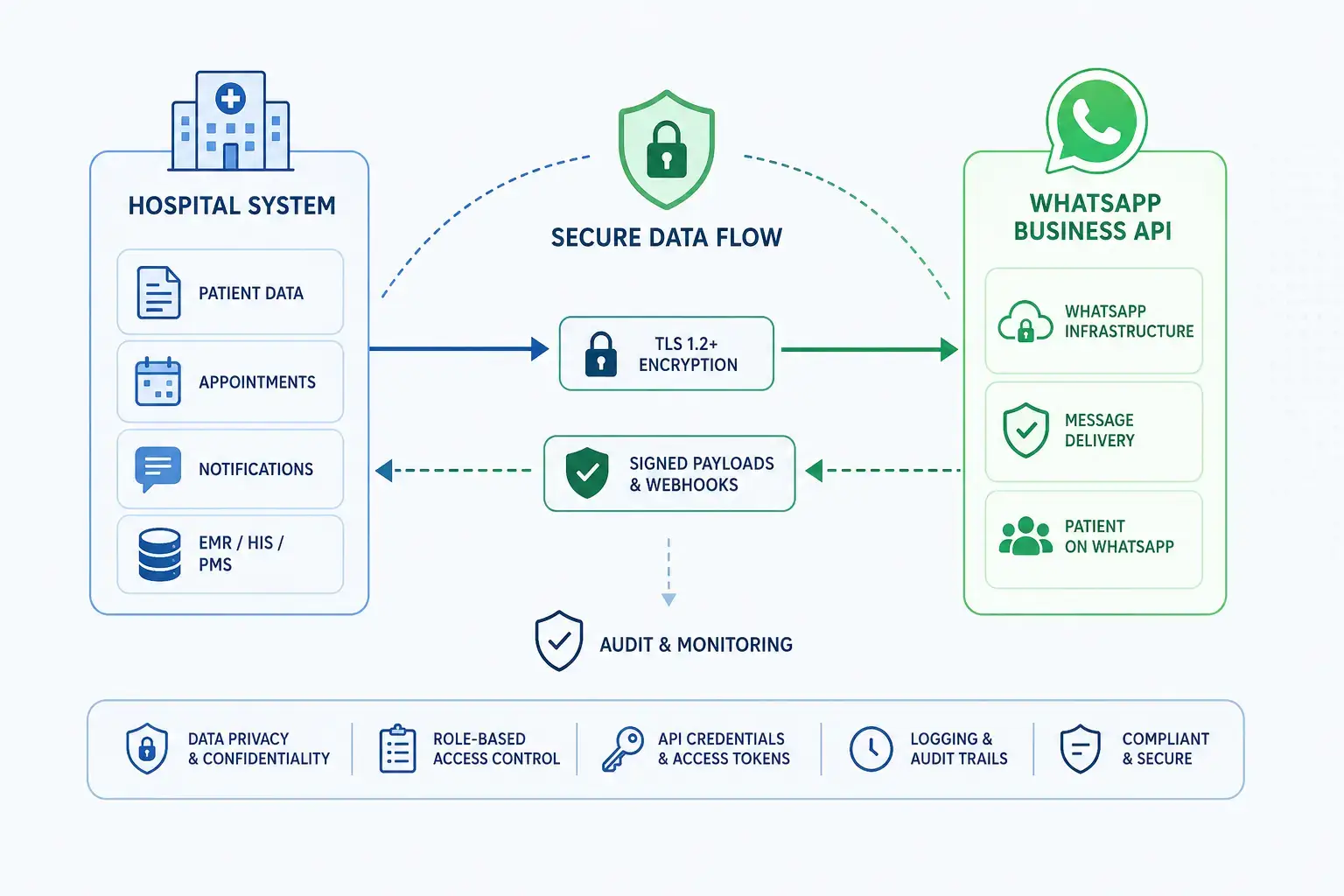
Where it plugs in
- Hospital Information Systems (HIS) and EMR / EHR platforms
- CRM and appointment scheduling software
- Pharmacy and billing systems
- India: forward-compatible with ABDM/ABHA-aligned systems
What Actually Matters When You Pick a WhatsApp API Partner for Healthcare
Most providers look identical on a features page. These are the things that actually separate them once you're live and a template gets rejected on a Friday afternoon.
-
Official Meta Business Partner status Direct standing with Meta, not a reseller of a reseller.
-
Real healthcare template experience Providers who have actually gotten clinical-adjacent templates approved, not just generic ones.
-
Presence in your actual markets Intigate operates across India, UAE, Kuwait, Qatar, and Singapore.
-
Integration support for your existing stack HMS, EMR, or CRM, connected properly instead of bolted on.
-
Someone to call when a template gets paused Meta's automated enforcement happens to everyone eventually. What matters is who picks up the phone.
Book a Free Consultation
Tell us about your clinic or hospital group. We'll map your use cases and compliance needs before recommending anything.
- Book a 20-minute call
- We map your use cases and compliance needs
- Get a rollout plan within [X business days]
Where WhatsApp Isn't the Right Tool
WhatsApp Business API is not a replacement for a dedicated clinical messaging system when providers need to exchange detailed PHI directly with each other. It should not be your sole channel for emergency or time-critical clinical communication. And because every template goes through Meta's review and enforcement system, there's inherent latency and risk that a purpose-built healthcare messaging platform doesn't carry.
In practice, most providers run both: a dedicated HIPAA-grade platform for provider-to-provider clinical communication, and WhatsApp Business API for the patient-facing logistics layer, appointments, reminders, and report notifications, where reach and response speed matter more than carrying clinical detail. That combination is usually the right one, not an either-or choice.
Frequently Asked Questions
No, not on its own. Meta does not sign a Business Associate Agreement for any WhatsApp product, and a BAA is required before a platform can be used to transmit Protected Health Information under HIPAA. WhatsApp Business API works well for appointment logistics and non-clinical updates, but clinical detail should stay off the channel unless a patient has specifically requested WhatsApp as their confidential communication channel.
You can legally notify a patient that a report or prescription is ready, without including the clinical content in the message itself. A short template that redirects the patient to a secure portal or asks them to call the clinic keeps you out of PHI territory while still using WhatsApp's speed and open rates.
Most healthcare rollouts move through Meta Business verification, template design and approval, and integration with your existing systems in a phased timeline. Exact timing depends on how many templates you need approved and how complex your HMS or EMR integration is, so we scope this on the initial call rather than quoting one number for every provider.
Yes. WhatsApp Business API connects to hospital information systems, EMR and EHR platforms, CRM tools, and pharmacy or billing software through standard API and webhook integration, so messages can trigger automatically from events like an appointment booking or a report becoming available.
Both. A single-doctor clinic typically starts with a smaller template set covering bookings and reminders, while multi-location hospital groups scale into report delivery, front-desk deflection, and cross-branch patient engagement. The underlying setup is the same; the template list and integration depth just grow with you.
Ready to See What Compliant Patient Messaging Looks Like?
Book a free consultation and we'll map your appointment, reporting, and follow-up workflows onto a template set that's built to hold up, not just launch fast.
Book a Free Consultation