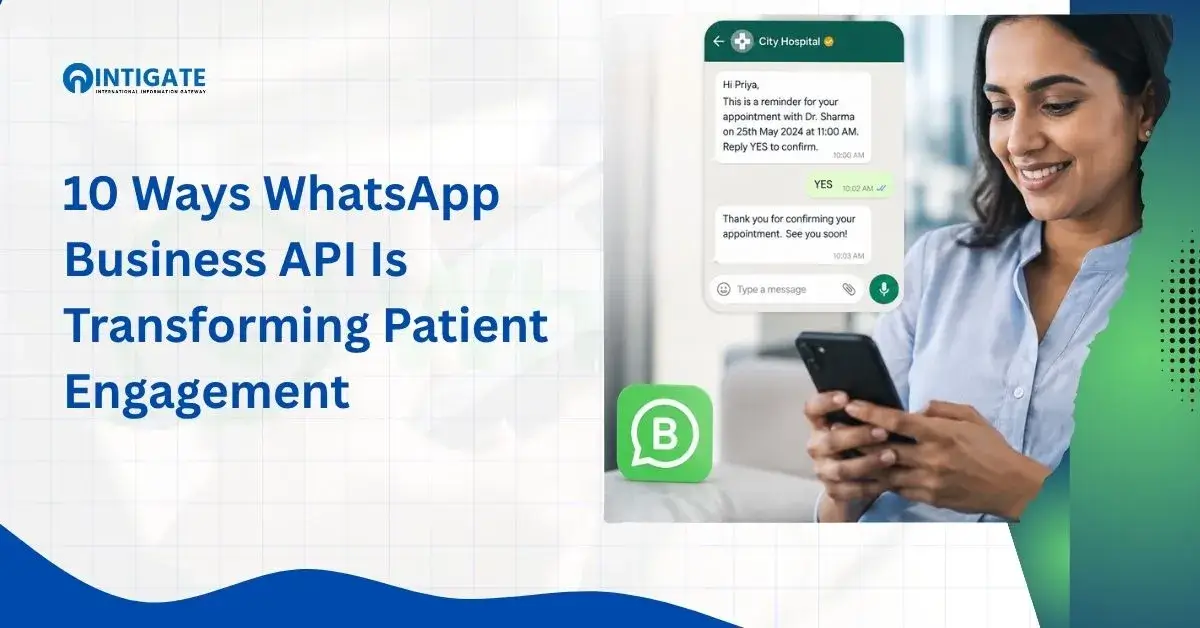
10 Ways WhatsApp Business API Is Transforming Patient Engagement
- WhatsApp Business API — officially the WhatsApp Business Platform — supports ongoing, two-way, consent-based patient communication such as follow-ups, education, and preventive care, not just appointment logistics.
- The platform reaches more than 3 billion monthly active users worldwide, which is why hospitals and clinics use it as a channel patients already check daily.
- Meta does not sign a Business Associate Agreement for WhatsApp, so clinical detail should stay off the channel unless a patient has specifically requested it as their preferred confidential channel.
- The 10 use cases in this guide span post-visit follow-ups, chronic care nudges, feedback loops, and multilingual outreach, all scoped to patient engagement rather than basic booking logistics.
- Measuring success requires tracking opt-in rate, response rate, and repeat-visit rate — not just message volume.
Patient engagement drops off the moment a patient leaves the building. Phone-based follow-up depends on someone picking up. Portal logins get forgotten within a week.
Email open rates for care-related messages are low enough that most providers have quietly stopped relying on them for anything time-sensitive.
WhatsApp for patient engagement addresses a specific version of this problem: it moves follow-ups, education, and preventive reminders onto a channel patients already open dozens of times a day, on infrastructure a hospital doesn’t have to build from scratch.
That shift has become harder to ignore in 2026. Patients now expect the same responsiveness from a hospital that they get from a delivery app or a bank, and providers still running outbound-call-only follow-up are losing that comparison in real time. WhatsApp Business API for healthcare gives hospitals and clinics a Meta-verified way to run that communication at scale without turning it into another unmanaged inbox.
This guide covers 10 specific ways the WhatsApp Business Platform is used for patient engagement, where it fits next to existing patient communication software, and how to measure whether it’s actually working.
See how a compliant WhatsApp Business API setup handles follow-ups, education, and feedback in one thread.
Book a Free Consultation →What Is WhatsApp for Patient Engagement?
WhatsApp for patient engagement is the use of the WhatsApp Business Platform (commonly still called the WhatsApp Business API) for ongoing, two-way, consent-based communication with patients between visits — follow-ups, health education, preventive care reminders, and feedback collection.
It is distinct from using WhatsApp only for appointment booking and reminders, which is a narrower, transactional use case and the one most hospitals implement first without going further.
10 Ways WhatsApp Business API Is Transforming Patient Engagement
1. Post-Visit Follow-Ups and Recovery Check-Ins
Most patient relationships go quiet the moment a visit ends.
A structured WhatsApp follow-up sequence checks in during the recovery window that actually matters for a given procedure or diagnosis, not with a generic “how are you feeling” message sent weeks later on no particular schedule.
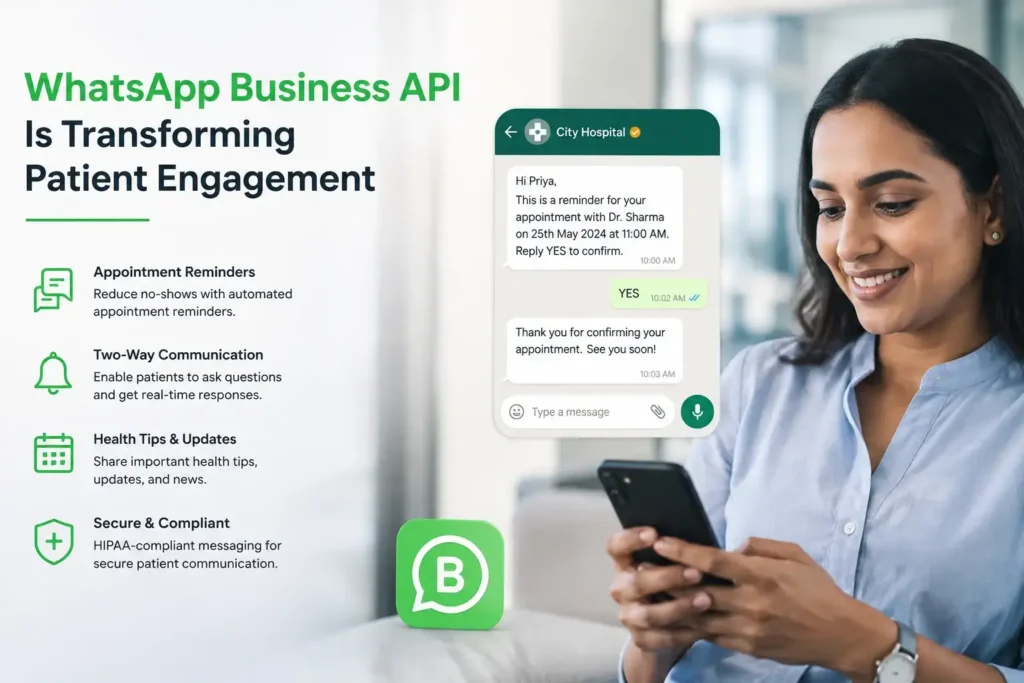
In practice, that means a short, templated check-in 24–48 hours after discharge, followed by a second message a week out if the care plan calls for it.
Patients reply directly in the same thread, and front-desk or care-coordination staff see the response in real time instead of waiting on a callback that’s statistically unlikely to happen.
2. Preventive Care and Screening Reminders
Preventive care is one of the easiest things to let slip, for patients and providers alike.
The WhatsApp Business Platform lets a clinic trigger reminders automatically when a patient becomes due for an annual checkup, a vaccination, or an age-appropriate screening, pulled from data already sitting in the practice management system rather than tracked separately.
Smaller clinics benefit here in a specific way: this kind of proactive, rules-based outreach used to require a dedicated care coordinator’s time. Automated, it doesn’t.
3. Chronic Care and Medication Adherence Nudges
For patients managing a long-term condition, adherence is one of the biggest levers on outcomes, and the scale of the problem is measurable, not anecdotal.
In a multicenter analysis of 1,111 hospital readmissions, 16% were medication-related, and of those, 40% were judged potentially preventable, with non-adherence accounting for roughly a third of the preventable cases, on par with prescribing errors as a root cause.
A WhatsApp-based nudge sequence, refill reminders, dosage check-ins, a simple “have you taken today’s dose” prompt — keeps that conversation active without requiring a phone call the patient is likely to let ring out.
It works especially well layered on top of a CRM or EMR that already tracks prescription and refill data, since the trigger logic can run off data the provider already has rather than a separate tracking system.
4. Two-Way Conversational Support
The gap between a one-way SMS blast and an actual conversation is where most patient engagement tools quietly fail.
WhatsApp is built for two-way exchange by default, so a patient can reply to a reminder with a question instead of ignoring it or calling the front desk on a separate channel to ask the same thing.
That design difference, reply-in-thread versus reply-nowhere, is the mechanism behind why WhatsApp tends to outperform SMS and email on response rate for patient communication specifically.
It’s not that patients prefer WhatsApp in the abstract; it’s that a channel built for two-way exchange gets used for two-way exchange, and a broadcast channel doesn’t.
5. Personalized Health Education Content
Care instructions delivered verbally during a rushed consultation are easy to forget within the hour.
WhatsApp lets a provider follow up with the same information in writing, in richer formats than a printed handout allows: a PDF discharge summary, a short video demonstrating a wound-care technique, or a pre-procedure prep guide the patient can reread at home the night before.
Rich media messaging: the ability to send documents, images, and video alongside text in the same conversation thread, instead of relying on a phone call or a printed handout the patient may not have with them.
6. Feedback Collection and Patient Satisfaction Loops
Most patient feedback loops are broken by design.
A satisfaction survey buried in an unopened email tells a hospital nothing.
A short WhatsApp-based CSAT or NPS prompt, sent in the same thread as the visit follow-up, gets answered because it’s low-friction and arrives on a channel the patient already checks.
This closes a loop most competing content on this topic doesn’t address at all, and it gives administrators a live signal on where care coordination is working and where it isn’t, instead of a quarterly survey report that arrives too late to act on.
7. Multilingual, Accessible Communication
Language is a real barrier to engagement, and one that generic patient portals rarely solve well.
The WhatsApp Business Platform supports templated messaging in multiple languages, which matters directly for a provider operating across India, the UAE, Kuwait, Qatar, and Singapore, where patient populations can be linguistically diverse within a single city, let alone a single country.
A patient who receives a preventive care reminder in their preferred language is more likely to act on it than one who receives it in a language they only partially read, a small design choice with a disproportionate effect on whether the message does anything at all.
8. Wellness Campaigns and Health Drive Announcements
Seasonal vaccination drives, community health camps, and wellness campaigns depend on reach, and WhatsApp’s install base gives providers a direct line to opted-in patients that outperforms a poster in the waiting room or a one-off SMS blast.
Every one of these messages still has to sit inside Meta’s Marketing message category and follow explicit opt-in rules, a separate approval track from the Utility category used for reminders and follow-ups.
For hospital groups running these campaigns at volume, this overlaps with broader outreach infrastructure such as Bulk WhatsApp Marketing Service in India, where the same template and consent framework applies.
9. CRM and EMR-Connected Engagement at Scale
Generic broadcast messaging treats every patient the same, which is a weak version of engagement dressed up as a strong one.
Connecting the WhatsApp Business Platform to a CRM or EMR lets a hospital segment outreach so a diabetic patient receives different nudges than a maternity patient, based on data the system already holds rather than a manually maintained list.
This is where patient engagement stops being a messaging feature and becomes a workflow — one that scales from a single clinic’s patient list to a multi-branch hospital group without changing the underlying communication channel, only the segmentation logic behind it.
10. A Verified, Trusted Channel That Increases Response Rates
Trust isn’t a soft metric here. A Meta-verified sender identity means a patient sees a recognizable clinic name instead of an unknown number, and that recognition is a direct factor in whether a message gets opened at all rather than screened as spam.
Combined with WhatsApp’s end-to-end encryption, it gives patients a concrete reason to engage with provider outreach instead of ignoring it by default.
Compliance is what makes that trust durable rather than accidental, which is worth answering directly.
Is WhatsApp Safe and Compliant for Patient Engagement?
The honest answer depends entirely on what’s in the message.
A Business Associate Agreement, a legally required contract between a healthcare provider and any vendor that handles protected health information on its behalf, is a foundational requirement under HIPAA for any platform carrying PHI.
Meta does not offer a Business Associate Agreement for any WhatsApp product, which means WhatsApp cannot be used to transmit protected health information in a HIPAA-compliant way, regardless of its encryption.
In practice, this means WhatsApp-based patient outreach should stay focused on logistics, education, and check-ins, not clinical detail, unless a patient has specifically opted into WhatsApp as their preferred confidential channel.
For the full compliance breakdown across HIPAA, India’s DPDP Act, and GCC health data regulations, see WhatsApp Business API for healthcare.
WhatsApp Business API vs. Patient Communication Software: Where It Fits
A common point of confusion is whether the WhatsApp Business Platform replaces dedicated patient communication software or an EMR’s messaging module. It does neither.
WhatsApp Business API is the messaging layer, the channel patients actually respond to, while patient communication software or an EMR remains the system of record for patient data, scheduling, and clinical workflows.
| Capability | WhatsApp Business API | Dedicated Patient Communication Software / EMR |
|---|---|---|
| Patient-facing reach | Very high — patients already use it daily | Depends on portal adoption, typically lower |
| Stores clinical data / PHI | No — not HIPAA compliant on its own | Yes, built for PHI with a signed BAA |
| Two-way conversational messaging | Yes, native | Varies — often one-way notifications |
| Scheduling and EMR workflows | No — needs integration | Yes, core function |
| Best used for | Reminders, follow-ups, education, feedback | Clinical documentation, scheduling, PHI storage |
The two are meant to work together, not compete.
Most providers run patient communication software or an EMR as the backend, with WhatsApp Business API Provider integration handling the patient-facing messaging layer on top of it.
How to Start Using WhatsApp Business API for Patient Engagement
- Define your engagement use cases first. Decide which of the 10 use cases above matter most for your patient population before touching any technical setup. A single clinic might start with post-visit follow-ups alone.
- Complete Meta Business verification. This is a prerequisite for WhatsApp Business Platform access and establishes the verified sender identity patients will see.
- Build compliant message templates, and know which category they fall into. Meta routes every template into one of four categories — Utility (transactional, tied to a patient action, like a follow-up or reminder), Marketing (campaigns and wellness drives, requiring explicit opt-in), Authentication (OTPs and verification), and Service (free-form replies inside an open 24-hour window). Healthcare templates should default to Utility wherever the content is transactional — Meta reviews and can reclassify a template that’s mislabeled to dodge the Marketing rate.
- Integrate with your HIS, EMR, or CRM. This is what turns WhatsApp from a manual messaging tool into an automated engagement workflow. Budget planning at this stage should account for both platform fees and Meta’s own per-category charges, which vary by recipient country; see WhatsApp API for Business Charges for a full breakdown.
- Launch with one use case, then expand. Start narrow, measure results, and add additional engagement workflows once the first one is proven.
How to Measure Patient Engagement Success on WhatsApp
Message volume is not a success metric on its own. Track these instead:
- Opt-in rate: the percentage of eligible patients who consent to WhatsApp communication.
- Response rate: how many patients reply to or act on a message, not just open it.
- No-show reduction: measured against a pre-WhatsApp baseline. Missed GP appointments alone cost the NHS more than £216 million a year in England — a 2019 figure that still gives a useful sense of scale for what providers are working to reduce.
- Repeat-visit rate: whether patients who receive preventive care and follow-up messaging return for recommended care at higher rates than those who don’t.
- CSAT/NPS score: collected directly through the feedback loop described above.
See Your Engagement Numbers Before You Commit We’ll map your current follow-up and preventive care gaps against a WhatsApp Business API rollout plan, with a realistic timeline for your clinic or hospital group.
Book a Free Consultation →Conclusion
This kind of patient engagement works because it meets patients on a channel they already check, not because it’s a novelty.
The 10 use cases here, from post-visit follow-ups to chronic care nudges to multilingual outreach, are what separate patient engagement from basic appointment logistics, and none of them require compromising on compliance if the templates and integration are built correctly from the start.
The providers getting real value from this aren’t the ones sending the most messages.
They’re the ones tracking response rate and repeat-visit rate, and treating the WhatsApp Business Platform as one connected layer in a larger patient communication strategy, not a replacement for the systems that already hold patient data.
Frequently Asked Questions
Is WhatsApp HIPAA compliant for patient engagement?
No, not on its own. Meta does not sign a Business Associate Agreement for any WhatsApp product, which HIPAA requires before PHI can be transmitted legally. WhatsApp works well for logistics, follow-ups, and education, but clinical detail should stay off the channel unless a patient specifically requests it.
What is the WhatsApp Business Platform, and is it the same as the WhatsApp Business API?
Yes — WhatsApp Business Platform is Meta’s current official name for what’s commonly still called the WhatsApp Business API. It’s distinct from the free WhatsApp Business app: the Platform is built for automated, template-based messaging at scale through integrations like an EMR or CRM, rather than manual conversations from a single phone.
How is WhatsApp different from SMS for patient engagement?
WhatsApp supports genuine two-way conversation, rich media like PDFs and video, and a verified sender identity — none of which SMS handles well. That design difference is a large part of why WhatsApp tends to see higher patient response rates than plain SMS reminders.
How much does WhatsApp Business API cost for a hospital or clinic?
Cost depends on message category and recipient country. Meta charges per message across four categories — Utility, Marketing, Authentication, and Service — with Utility and Authentication priced well below Marketing, and Service messages free within an open 24-hour customer window. On top of Meta’s charges, most providers also pay a platform fee to whichever WhatsApp Business Solution Provider handles the integration.
Is WhatsApp for patient engagement only useful for large hospital groups?
No. A single clinic can start with one use case, such as post-visit follow-ups, using a small template set. Multi-location hospital groups scale into segmented, CRM-connected engagement, but the underlying setup works the same way at either size.