WhatsApp Business API Cost in 2026: What You’re Actually Paying (And What You’re Not)
- WhatsApp Business API cost in 2026 has two separate layers — Meta’s per-message fee and your platform provider’s subscription or markup — and most businesses only budget for one.
- Meta switched from per-conversation to per-message billing on July 1, 2025; any guide written before that date is using an outdated pricing model.
- Service messages (customer-initiated conversations) are free and unlimited; the 24-hour and 72-hour free windows can eliminate a significant portion of your monthly bill if used strategically.
- Marketing message rates vary dramatically by recipient country — India costs roughly ₹0.85–₹0.90 per message while UAE sits at approximately $0.0499, with Saudi Arabia’s marketing rate increasing effective April 1, 2026.
- India businesses on the WhatsApp Business API must migrate their WABA (WhatsApp Business Account) to INR billing by December 31, 2026, or risk message delivery being suspended from January 1, 2027.
WhatsApp Business API cost is one of the most searched and most misunderstood topics in business messaging today, and the confusion is justified.
Meta changed its pricing model on July 1, 2025, moving from per-conversation billing to per-message billing. Most guides online still reference the old model.
Meanwhile, 5 million businesses globally now rely on the WhatsApp Business API for customer communication (Meta disclosures, compiled by Mobilesquared, 2025). That number is growing fast enough that getting the cost model wrong carries real budget consequences.
This article cuts through that confusion.
You will get a clear breakdown of what Meta charges, what your platform provider charges on top, how free messaging windows can dramatically reduce your bill, and what the current per-message rates look like specifically for India and GCC markets — the two regions where the cost structure is most frequently misunderstood.
Intigate Technologies is an Official Meta Business Partner operating across India, the UAE, Kuwait, and the GCC.
The cost insights in this article reflect direct, first-hand experience with the platform’s billing mechanics.
Businesses with India + GCC customer bases face multiple rate cards, Authentication-International exposure, and an INR migration deadline. Intigate handles this routing and compliance as part of onboarding.
Talk to a WhatsApp API Specialist →The Two-Layer Cost Structure Most Businesses Miss
WhatsApp Business API cost is not a single line item; it is always the sum of two separate charges that operate independently of each other.
Layer 1 — Meta’s per-message fees.
These are set by Meta, published on their developer pricing page, and are identical regardless of which provider you use.
A marketing message to a UAE recipient costs the same whether you access the API through Twilio, a regional provider, or an Official Meta Business Partner like Intigate.
These rates are non-negotiable.
Layer 2 — Platform or provider fees.
This is where providers diverge significantly. Some add a flat per-message markup of $0.003–$0.010 on top of Meta’s base rate.
Others charge a monthly platform subscription and pass Meta’s fees through at cost. Some add percentage markups of 10–20%.
A few also charge per-agent seat fees ($15–$30/seat/month) and onboarding or setup fees that can reach $1,000.
Most businesses researching WhatsApp API pricing only calculate Layer 1. The actual bill reflects both.
Total WhatsApp API Cost = Meta per-message fee × monthly message volume + Platform/BSP fee
Run this calculation separately for each message category and each recipient market.
Summing across categories before accounting for country differences produces inaccurate budget forecasts.
Meta’s 4 Message Categories — The Foundation of Your Bill
WhatsApp Business API message category: A classification Meta assigns to every outbound template message that determines the per-message rate you pay for delivery.
There are four categories, each priced differently.
Marketing Messages: Highest Per-Message Cost
Marketing messages cover promotional content: campaign broadcasts, product announcements, re-engagement flows, and newsletters.
These are the most expensive category. Meta charges for every delivered marketing message regardless of whether a customer service conversation is already open, and volume discounts do not apply to this category.
As of Q2 2026 (Meta developer pricing documentation):
- India: ~₹0.85–₹0.90 per delivered message (increased approximately 10% on January 1, 2026)
- UAE: ~$0.0499 per delivered message
- Saudi Arabia: Higher rate effective April 1, 2026 (verify current figure at the Facebook official site).
- Germany (global benchmark): ~€0.11–€0.12 per message — roughly 13× more expensive than India
Utility Messages: Transactional and Often Free
Utility messages are transaction-linked updates: order confirmations, shipping notifications, payment receipts, and appointment reminders. This category costs approximately 80–90% less per message than marketing, and utility templates sent within an open 24-hour customer service window are delivered at no charge.
Volume discounts also apply to utility messages, meaning high-volume operations unlock lower per-message rates automatically.
Misclassifying utility messages as marketing is one of the most consistently expensive mistakes businesses make on the platform.
Authentication Messages: Cheapest Domestic, Potentially Expensive Cross-Border
Authentication messages handle OTPs and identity verification. Domestic authentication costs are among the lowest on the platform — approximately $0.0025 per message in India.
However, the Authentication-International rate is a category of hidden cost that frequently surprises GCC-based businesses.
Authentication-International applies when OTPs are sent cross-border to users in specific markets, including the UAE, Saudi Arabia, Egypt, Nigeria, Pakistan, and India, where the sender’s business jurisdiction differs from the recipient’s market.
These rates are 3–18× higher than standard domestic authentication rates.
If your operation is registered in India but sends OTPs to UAE customers — or vice versa — Authentication-International rates apply to those sends.
Service Messages: Always Free
Service messages are all replies sent within a customer-initiated 24-hour conversation window. Meta made service conversations fully free and unlimited on November 1, 2024 (Meta Pricing Documentation, 2024).
There is no cap.
An entire troubleshooting session, onboarding conversation, or consultative sales exchange stays free as long as the customer continues engaging within each 24-hour window. The timer resets with every customer message.
The critical constraint: you cannot send marketing or authentication templates under this free window. It is restricted to free-form replies and utility templates.
WhatsApp Business API Cost by Country: India and GCC Rates
Your WhatsApp Business API cost by country is always based on the recipient’s country code, not your business location.
An Intigate client based in Noida messaging a customer in Dubai pays UAE rates — not India rates. This is a critical detail for any business operating across both markets.
| Market | Marketing (per message) | Utility (per message) | Auth — Domestic | Auth-International |
|---|---|---|---|---|
| India | ~₹0.85–₹0.90 (~$0.0094) | Significantly lower | ~$0.0025 | Higher (increased April 1, 2026) |
| UAE | ~$0.0499 | Lower | Standard rate | Applies |
| Saudi Arabia | Higher (increased April 1, 2026) | Lower | Standard rate | Applies |
| Kuwait / Rest of GCC | Regional “Rest of” rate | Regional rate | Regional rate | Verify |
| Germany (global reference) | ~€0.11–€0.12 | Lower | Lower | Not applicable |
Source: Meta WhatsApp Business Platform Pricing Documentation, effective Q2 2026. Verify live rates at developers.facebook.com/documentation/business-messaging/whatsapp/pricing before budgeting.
India billing localisation: Meta launched INR billing for eligible Indian businesses on January 1, 2026.
All WhatsApp Business Accounts belonging to India-registered businesses must be migrated to INR currency by December 31, 2026.
From January 1, 2027, Meta will no longer deliver messages from non-INR WABAs of eligible India customers (Meta Developer Documentation, 2026).
If your operation is India-based, this migration is not optional.
Two Free Windows That Can Materially Reduce Your Monthly Bill
Most businesses calculating WhatsApp Business API cost overlook the free messaging windows available to them — windows that can eliminate a significant portion of template charges.
Together, these two mechanisms can eliminate a significant portion of template message costs.
How to Use the 24-Hour Service Window
When a customer sends your business a message, any message, a 24-hour free window opens.
Every reply you send within that window is free, including utility templates. The window resets each time the customer responds, meaning an active conversation can remain in the free zone indefinitely.
Strategy: Design your inbound channels, website chat widgets, QR codes, email signature links, and social media — to drive customers to message you first. Every customer-initiated conversation shifts the cost structure in your favour.
How to Use the 72-Hour Click-to-WhatsApp Ad Window
When a customer enters your WhatsApp from a Click-to-WhatsApp ad on Facebook or Instagram, or from a Facebook Page CTA button, Meta waives all message charges, including marketing template charges, for the following 72 hours.
This is Meta’s most underutilised cost-saving mechanism.
How to activate it (step-by-step):
- Create a Click-to-WhatsApp (CTWA) ad on Facebook or Instagram targeting your audience segment.
- Customer clicks the ad and opens a WhatsApp conversation with your business.
- The 72-hour free window activates immediately upon first contact.
- Send your qualification flow, product information, and CTAs — all at zero per-message cost.
- Convert within 72 hours. After that, if the customer has not replied, the window closes, and standard template rates resume.
The only cost within this window is your ad spend. For high-intent campaigns, this structure makes Click-to-WhatsApp ads among the most cost-efficient customer acquisition formats available through Meta’s ecosystem.
What Provider (Platform) Fees Actually Look Like
This is where the total WhatsApp Business API cost calculation most frequently breaks down for finance teams.
Providers officially called WhatsApp technology partners or Business Solution Providers (BSPs) — structure their fees in materially different ways:
- Per-message markup: +$0.003–$0.010 per message added on top of Meta’s base rate. Compounds significantly at scale — at 1 million messages per month, a $0.005 markup adds $5,000 to your bill.
- Percentage markup: 10–20% above Meta’s rates. Variable and difficult to forecast.
- Monthly flat subscription + Meta passthrough: Platform fee covers the dashboard, automation, analytics, and integrations. Meta’s rates are passed through at cost with no markup. Most predictable model for high-volume operations.
- Per-seat agent fees: $15–$30/agent/month. A 10-agent team adds $150–$300/month before messaging costs.
- Onboarding/setup fees: Up to $1,000 in some cases, covering number activation, business verification, and display name approval.
Before signing with any WhatsApp technology partner, clarify these four questions:
- Do you pass through Meta’s rates at cost, or do you add a per-message markup?
- Are agent seats charged separately?
- Is there an onboarding or setup fee?
- What is your typical time-to-first-message after account activation?
For a full comparison of how leading WhatsApp Business API Providers structure their fees and what separates a cost-effective partnership from an expensive one, see our in-depth breakdown.
Real Monthly Cost Scenarios: India and UAE
The examples below show WhatsApp Business API cost at two common operational scales in Intigate’s primary markets.
Scenario 1: Indian SMB (10 agents, mixed use)
- 5,000 utility messages + 1,000 marketing messages per month
- Estimated Meta fee at India rates: ~₹4,000–₹5,000
- Estimated platform fee: ~₹1,500–₹2,500
- Estimated total: ₹5,500–₹7,500/month
This aligns with published benchmarks: a typical 10-agent WhatsApp operation in India runs ₹3,500–₹7,500 all-in monthly, with roughly 40% attributable to platform fees and 60% to Meta’s charges.
Scenario 2: UAE-based business (e-commerce, automated order updates + weekly campaigns)
- 10,000 utility + 3,000 marketing messages per month
- Estimated Meta fee at UAE rates: ~$500–$650
- Estimated platform fee: ~$80–$150
- Estimated total: ~$580–$800/month
UAE rates are approximately 5× India’s marketing rate per message, making audience segmentation and free window maximisation especially important for GCC operations.
For UAE enterprises, multiply the India-rate estimates by approximately 2.4 to get a working UAE approximation.
All scenarios use Q2 2026 Meta rate cards. Verify current rates before building a business case.
What’s Changing in WhatsApp API Pricing Through October 2026
The WhatsApp Business API cost model continues to evolve, and the changes through October 2026 affect budget planning directly. These are the confirmed upcoming changes as of Meta’s published pricing calendar:
Effective July 1, 2026: Marketing message rates are increasing in Italy, Spain, and the United Kingdom. Poland, Qatar, Singapore, Hong Kong, Hungary, and Romania will move from grouped “Rest of” regional rates to standalone country rate cards. Volume tier calculations will become market-specific for these countries.
Mid-2026 (Limited Beta) → October 2026 (Open Beta): Meta is introducing max-price bidding for marketing messages. Businesses will set a maximum price per delivered message; Meta charges that amount or less based on expected recipient engagement. Early projections suggest 15–25% cost savings for high-volume senders willing to accept optimised, rather than blanket delivery. This changes the economics of large marketing campaigns significantly.
October 1, 2026: Bangladesh, Iraq, Nepal, and Sri Lanka will receive standalone rate cards, with lower utility and authentication rates.
December 31, 2026: Deadline for Indian businesses to complete WABA currency migration to INR (Meta Developer Documentation, 2026).
To stay current, bookmark Meta’s official pricing calendar at developers.facebook.com/documentation/business-messaging/whatsapp/pricing.
5 Practical Steps to Lower Your WhatsApp Business API Cost
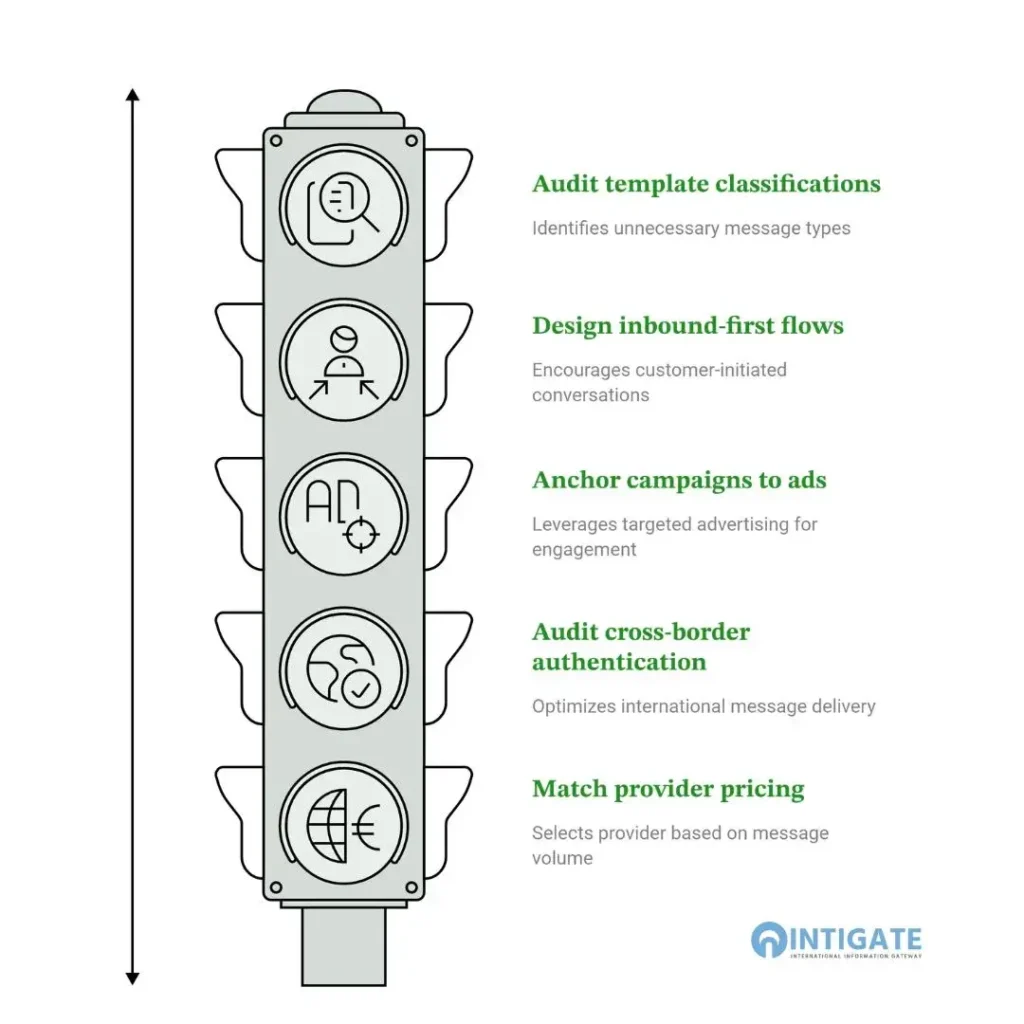
- Audit your template classifications. Confirm every utility message — order confirmations, shipping alerts, payment reminders — is submitted to Meta as a Utility template, not Marketing. The per-message cost difference is approximately 80–90%.
- Design for inbound-first flows. Add WhatsApp entry points (QR codes, website widgets, email CTAs) that encourage customers to message you. Every customer-initiated conversation opens a free 24-hour window.
- Anchor high-intent campaigns to Click-to-WhatsApp ads. Use CTWA ads to open 72-hour free windows before your primary conversion sequence. Your only cost is ad spend — not message delivery.
- Audit cross-border authentication sends. If you send OTPs to markets on the Authentication-International list (UAE, Saudi Arabia, Egypt, India from a non-India business, and others), those sends cost 3–18× more than domestic auth messages. Domestic OTP architecture eliminates this exposure.
- Match the provider pricing model to your volume. At low volumes, a flat monthly subscription is typically cheaper. At high volumes, percentage markups and per-message markups compound quickly — seek a provider that passes through Meta’s rates at cost.
Most businesses discover provider markups and hidden fees after the first billing cycle. Intigate provides a transparent cost model — Meta rates passed through at cost, no per-message markup — for businesses in India, UAE, Kuwait, and across the GCC.
Request a Free Cost Breakdown →Conclusion
WhatsApp Business API cost in 2026 is predictable once you understand its structure, but only if you account for both Meta’s per-message fees and your provider’s charges, understand which messages are free and when, and apply the correct country rates for your recipient base.
The three most important takeaways: First, the July 2025 switch to per-message billing changed how costs accumulate, and strategies built around the old conversation model are no longer accurate.
Second, the free Windows 24-hour service and 72-hour CTWA are the largest underutilised cost lever on the platform.
Third, the India INR migration deadline of December 31, 2026, is a compliance requirement, not a choice.
Businesses in India and the GCC that approach WhatsApp API costs strategically, not just as a messaging line item, will find it one of the highest-ROI communication investments available in 2026.
To deploy a transparent cost model with zero per-message markup, explore Intigate’s official WhatsApp Business API Solutions.
FAQ’s: WhatsApp Business API cost
What is the WhatsApp Business API cost in India in 2026?
In India, Meta charges approximately ₹0.85–₹0.90 per delivered marketing message as of Q2 2026 — a rate that increased roughly 10% on January 1, 2026. Utility messages cost significantly less, and authentication messages are among the cheapest globally at approximately $0.0025 per message. Service messages (customer-initiated) are free and unlimited. Add your platform provider’s fee for the total monthly cost.
Is WhatsApp Business API free?
The WhatsApp Business API cost is not zero. The API requires two types of payment: Meta’s per-message fee (charged per delivered template message by category and recipient country) and a platform or provider fee covering the dashboard, automation, and API access. The only free element in 2026 is service messages within a 24-hour customer-initiated conversation window.
How much does WhatsApp Business API cost per month for a small business?
For a small Indian business sending approximately 5,000 utility and 1,000 marketing messages monthly, total costs typically fall between ₹5,500–₹7,500 all-in, combining Meta’s charges and a platform subscription. UAE-based operations running similar volumes typically see $580–$800/month due to higher regional rates. Actual cost depends on your message mix, recipient countries, and provider pricing model.
Does WhatsApp charge per message or per conversation in 2026?
Since July 1, 2025, Meta charges per delivered template message — not per 24-hour conversation window as it did under the previous model (Meta Pricing Documentation, 2025). Service messages (customer-initiated free-form replies within 24 hours) are not charged under either model. Utility templates sent within an open customer service window are also free.
Beyond Meta’s published per-message rates, businesses frequently encounter provider markups (10–20% above Meta’s base rates, or flat per-message fees), per-agent seat charges ($15–$30/seat/month), onboarding and setup fees (up to $1,000), and Authentication-International rates for cross-border OTP delivery (3–18× higher than domestic authentication rates). Template rejection delays also carry an opportunity cost when campaigns are stalled pending Meta approval.