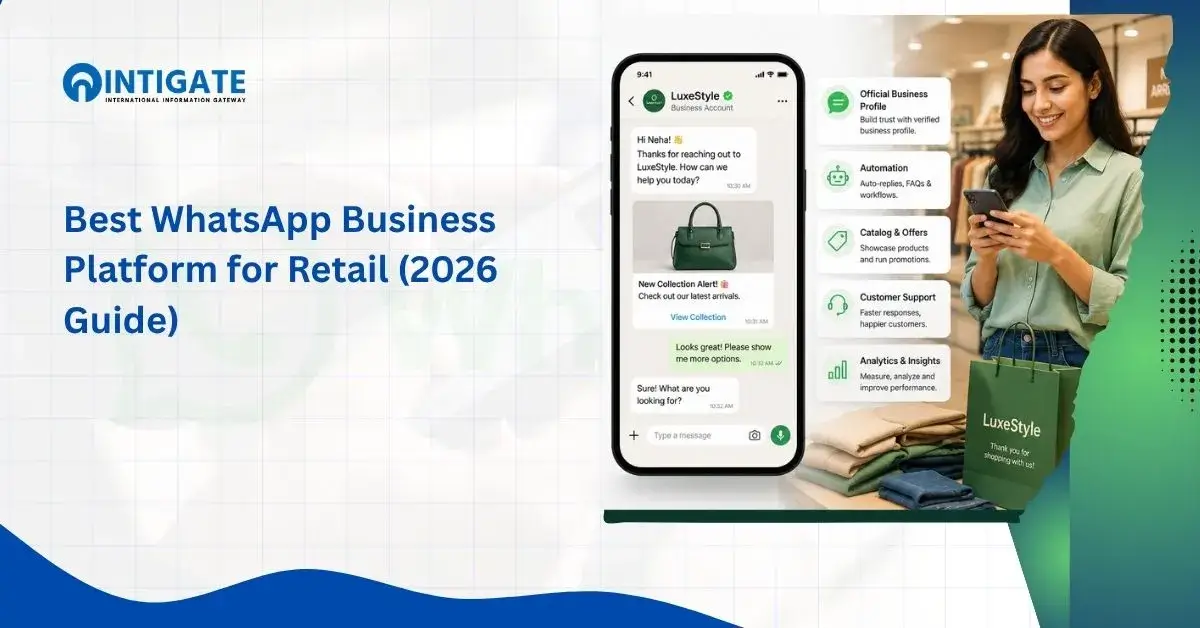
Best WhatsApp Business Platform for Retail (2026 Guide)
- The best WhatsApp Business Platform for retail comes down to three things: confirmed BSP status, catalog and cart recovery features built for retail rather than broadcast-only tools, and how a provider’s pricing lines up with Meta’s per-message billing, which changes again on October 1, 2026.
- Meta has confirmed that starting October 1, 2026, service messages and utility templates sent inside the open 24-hour customer service window stop being free. Service messages get a new monthly allowance of 1,000 free messages per business phone number. Utility templates in that window get no free allowance at all.
- WhatsApp-first tools built for India and the GCC, such as Intigate, WATI, AiSensy, Interakt, Gallabox, and DoubleTick, generally fit mid-market retailers better than enterprise customer engagement platforms that treat WhatsApp as one channel among many.
- Retailers operating in both India and the UAE need to evaluate platforms against two separate compliance frameworks: India’s Digital Personal Data Protection Act 2023 and the UAE’s Federal Decree-Law No. 45 of 2021.
Choosing the best WhatsApp Business Platform for retail in 2026 isn’t a one-time pricing decision.
It has to survive Meta’s next rate change, and one lands in three weeks.
On October 1, 2026, Meta starts charging for two message types retailers have relied on being free: service messages sent inside the 24-hour customer service window, and utility templates sent inside that same window.
That single change resets the cost math for anyone whose WhatsApp volume is mostly order confirmations, shipping updates, and customer replies, which describes most retail messaging.
Most comparison articles treat retail as a footnote next to healthcare, banking, and travel.
That misses what actually matters for a business owner in Mumbai or Dubai choosing between a whatsapp business api provider built for global enterprises and one built around how retail sells on WhatsApp: catalog browsing, cash-on-delivery confirmation, and abandoned cart recovery.
This guide covers what makes a platform retail-ready and exactly what changes in WhatsApp pricing on October 1, 2026.
It also compares the leading platforms and explains how India and GCC retailers should weigh compliance and buying behavior differently.
Intigate Technologies can map your utility and service message volume against the new rate card before it takes effect.
Talk to a WhatsApp API Specialist →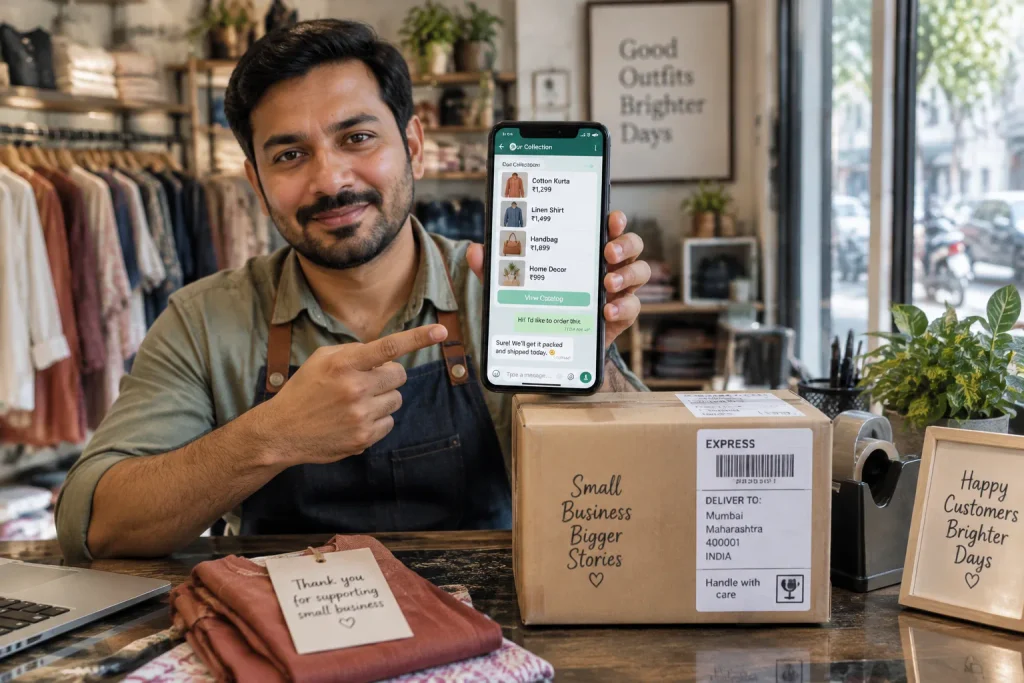
What Makes a WhatsApp Platform Retail-Ready in 2026
WhatsApp retail-ready platform: a WhatsApp Business Platform provider that combines confirmed Meta Business Solution Provider status with catalog, cart recovery, and order-verification features built for the buying journey, not only broadcast messaging.
A platform that only sends broadcasts is a marketing tool.
A retail-ready platform has to support the full path from product discovery to post-purchase support, and it has to survive Meta’s pricing changes without silently passing the increase straight to you.
Official BSP Status vs. Unofficial Gateways
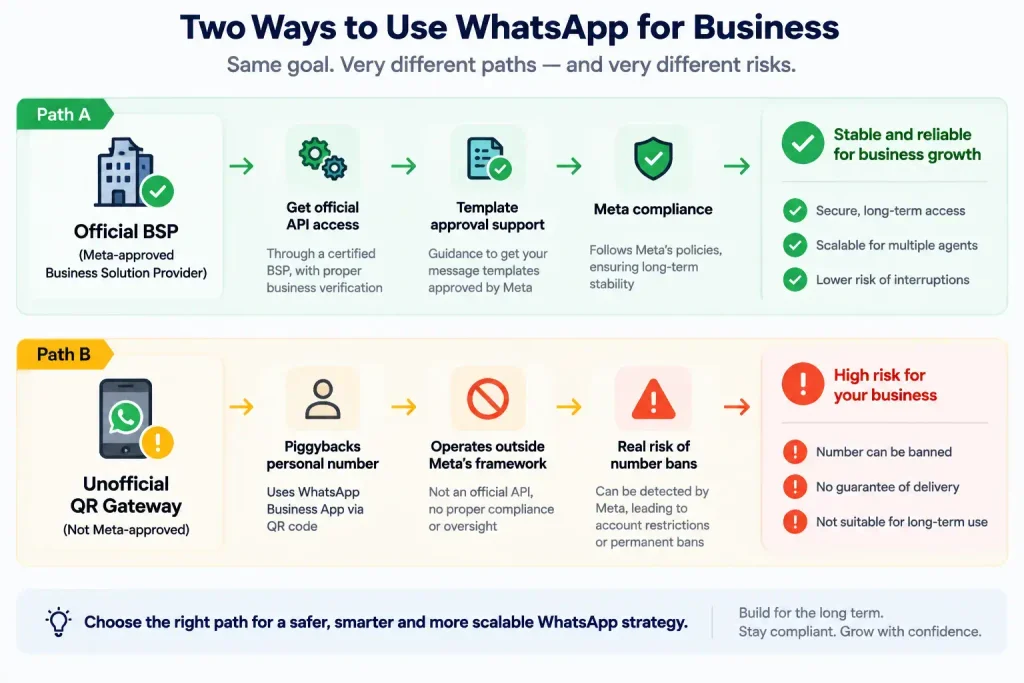
Business Solution Provider (BSP): a company Meta has officially authorized to provide access to the WhatsApp Business API on its behalf.
Only official BSPs can guarantee stable API access, template approval support, and compliance with Meta’s terms, as set out in Meta’s WhatsApp Business Platform pricing documentation.
Unofficial “QR code gateway” tools that piggyback on personal WhatsApp numbers carry a real risk of number bans, since they operate outside that framework.
Confirm BSP status before evaluating any other feature.
WhatsApp Catalog and Cart Recovery Support
WhatsApp catalog: a feature that lets a business list its products directly inside WhatsApp so customers can browse and ask questions without leaving the chat.
Catalog and cart recovery are what separate a general-purpose messaging tool from a retail-specific one.
WhatsApp is widely reported to have higher open rates than email, though the exact figure varies by source and is often repeated without a named methodology.
One vendor’s analysis of anonymized send data across 382 active brand accounts found a 79 percent open rate for WhatsApp campaign messages, and the same report flagged the commonly quoted “98 percent open rate” figure as a claim it could never trace to a documented primary source (Chatarmin, 2026).
Treat any open-rate or cart-recovery figure quoted without a stated methodology as an industry estimate, not an audited benchmark.
COD and OTP Verification Workflows (India/GCC-Specific)
Cash-on-delivery remains common in both Indian and GCC e-commerce, which makes WhatsApp-based OTP and delivery confirmation a practical fit for reducing failed deliveries.
Independently audited figures for the current COD share of India and GCC retail orders are hard to pin down; most numbers circulating in vendor blogs trace back to surveys that are several years old or don’t disclose sample size.
Confirm your shortlisted provider supports authentication-category templates specifically, since Meta prices that category separately from marketing and utility messages, and it runs far cheaper, commonly under a cent per message in South Asian markets.
How WhatsApp Business API Pricing Actually Works for Retail in 2026
Meta replaced conversation-based billing with per-message billing effective July 1, 2025.
This mattered more for retail senders than almost any other vertical, since retail messaging volume skews heavily toward utility templates: order confirmations, shipping updates, and delivery notices.
The per-message model charges based on the template’s category (marketing, utility, or authentication) and the recipient’s country calling code.
Non-template messages and utility templates sent inside an open customer service window have been free, and a 72-hour Free Entry Point window applies when a customer messages you first through a Click-to-WhatsApp ad or a Facebook Page button.
What Changes on October 1, 2026
This is the confirmed change every retail buyer needs to budget for now.
Starting October 1, 2026, Meta will charge for service messages and utility templates sent inside the previously free 24-hour customer service window, at the same regional rate it already charges for utility templates sent outside the window.
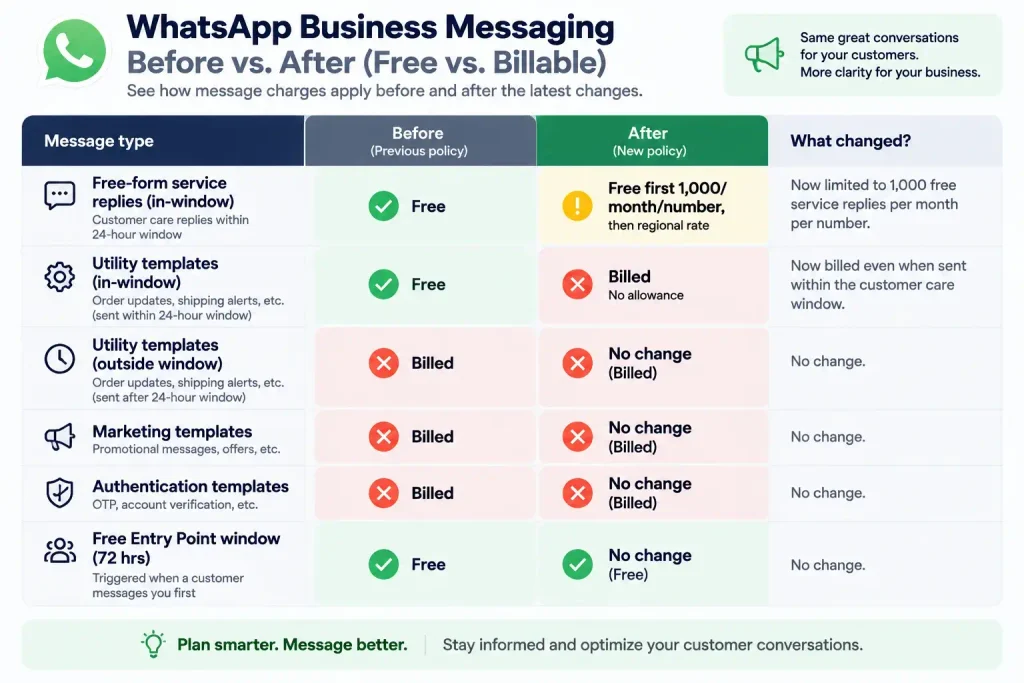
| Message type | Before October 1, 2026 | From October 1, 2026 |
|---|---|---|
| Free-form service replies inside the 24-hour service window | Free | Free for the first 1,000 per business phone number per month, then billed at the regional utility rate |
| Utility templates sent inside that same window | Free | Billed at the regional rate, no free allowance |
| Utility templates sent outside the window | Billed at the regional rate | No change |
| Marketing templates | Billed at the regional rate | No change |
| Authentication templates | Billed at the regional rate | No change |
| Messages inside an active 72-hour Free Entry Point window | Free | No change |
The free service-message allowance resets every calendar month, doesn’t roll over, and applies per business phone number, so a retailer running multiple WhatsApp numbers gets 1,000 free service messages on each number, not 1,000 shared across the account.
Utility templates get no such allowance. Every one you send is billable from October 1 onward, whether it lands inside or outside the service window.
For a typical mid-market retailer, the practical exposure comes from order and shipping notifications.
These are almost always sent as utility templates, and many were previously free when they landed inside an already-open service window, for example, a shipping update sent after a customer messaged support in the same 24 hours.
After October 1, that notification is billed like any other utility template.
Indicative 2026 Rates by Category
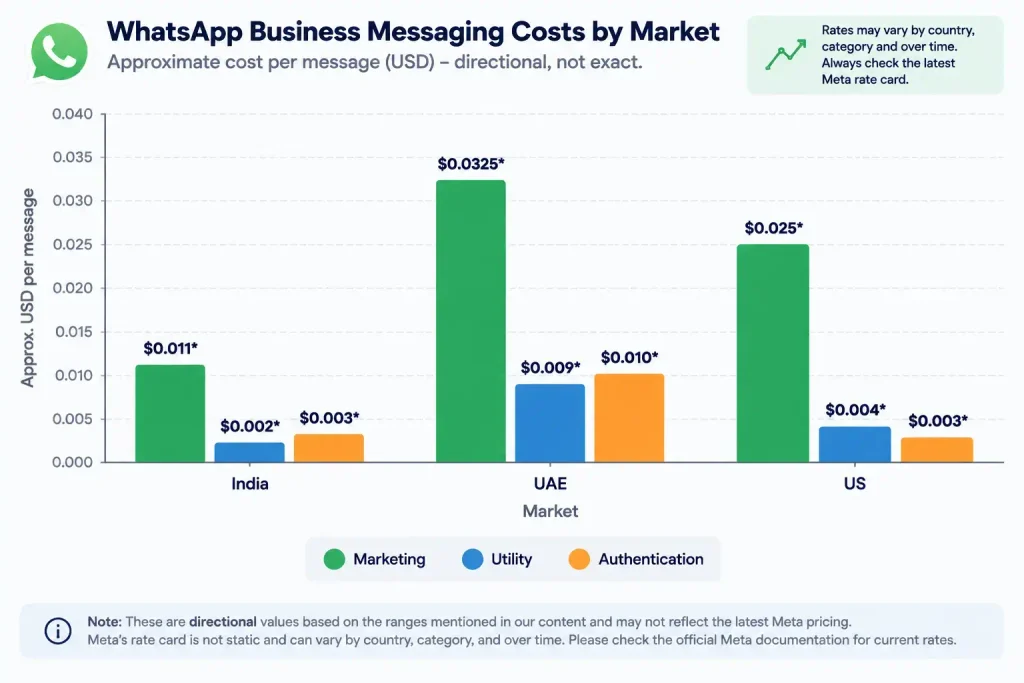
Meta doesn’t publish one static global number.
It publishes a rate card broken down by category and country calling code, updated on a periodic cycle, so treat the figures below as directional rather than exact.
Based on Meta’s published documentation and third-party rate trackers as of mid-2026:
| Market | Marketing (approx.) | Utility (approx.) | Authentication (approx.) |
|---|---|---|---|
| India | $0.010–$0.012 | $0.001–$0.003 | Under $0.003 |
| UAE | $0.030–$0.035 | $0.008–$0.010 | Under $0.010 |
| United States | ~$0.025 | ~$0.004 | ~$0.003 |
Utility messages typically run 80 to 95 percent cheaper than marketing messages in the same market.
Correctly categorizing order and shipping notifications as utility templates, rather than marketing, is one of the highest-leverage cost decisions a retailer makes when submitting templates for approval.
Confirm current numbers against Meta’s published rate card before budgeting, since it updates quarterly and can shift meaningfully between updates.
A Separate, Narrower Change: AI Provider Pricing
Meta also introduced a distinct pricing policy for third-party “AI Providers,” companies offering general-purpose AI assistants through the WhatsApp Business Platform.
Terms updated January 15, 2026, and charges for non-template messages from those providers began February 16, 2026, in markets where Meta is legally required to permit that use case.
This policy targets AI assistant providers specifically and doesn’t change how a typical retail sender is billed.
Don’t let a vendor conflate the two changes: the October 1 shift affects retail notification and support messaging.
BSP Markup Comparison
Every BSP adds its own markup on top of Meta’s per-message rate, and that markup, not Meta’s rate card, is usually where price variation between providers actually comes from.
Markup structures vary: some BSPs pass Meta’s rate through with a flat subscription fee, others add a per-message margin on top, and a few bundle both.
Ask any shortlisted provider for their exact markup by message category, in writing.
See cheapest whatsapp api for a breakdown of how to model costs against a specific provider’s quote.
The Leading WhatsApp Retail Engagement Platforms, Compared
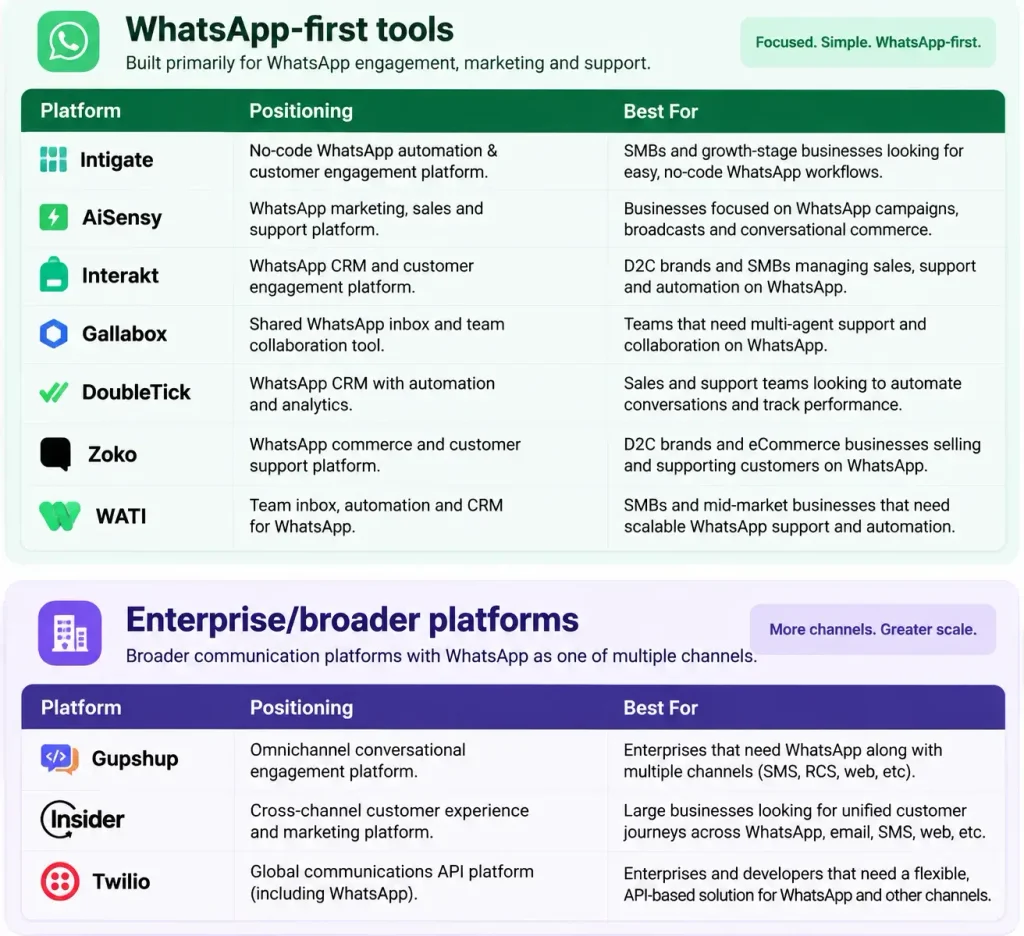
| Platform | Positioning | Retail-specific features | Best for |
|---|---|---|---|
| Intigate Technologies | Meta Business Partner serving India, UAE, Kuwait, and Qatar, with bulk WhatsApp marketing services built around regional compliance | Catalog, cart recovery, COD/OTP workflows, dual-region compliance documentation | India/GCC retailers wanting one provider across both markets |
| AiSensy | WhatsApp-focused engagement platform for promotional broadcasts, coupons, and carousel messages schedulable up to two months ahead | Broadcast automation, coupon flows | India-market SMBs running broadcast-led campaigns |
| Interakt | Jio Haptik product and Meta Business Partner built around India’s D2C market | Cart recovery, catalog, order tracking | India-based D2C brands wanting India-specific integrations |
| Gallabox | WhatsApp Business API platform with team inbox and workflow automation | Workflow builder, team inbox | Multi-agent retail support teams |
| DoubleTick | WhatsApp sales and broadcast tool positioned for SMB retail | COD-heavy catalog sales, broadcast | Small retail teams managing sales-led outreach |
| Zoko | WhatsApp-native commerce platform for Shopify-connected stores | Native Shopify sync, catalog checkout | Shopify-first D2C brands |
| Gupshup | Enterprise-grade conversational messaging platform across WhatsApp and other channels | High-volume conversational commerce, bot builder | Larger retailers needing high-volume conversational commerce |
| Insider | Omnichannel customer engagement platform with WhatsApp as one of 12+ channels | Full CDP, cross-channel journeys | Enterprise retailers already running a broader CDP |
| Twilio | Developer-focused communications API for WhatsApp, SMS, voice, and email | Build-your-own via API | Retailers with in-house engineering teams building custom flows |
| WATI | AI-native unified inbox across WhatsApp, Instagram, Facebook, SMS, and web chat; self-reports serving over 14,000 businesses globally | Catalog, broadcast, multi-channel inbox | Support-heavy retail teams needing one inbox across channels |
Subscription prices change too often across these providers to list reliably without going stale within weeks.
Get a current quote directly, and ask each vendor to itemize their platform fee separately from Meta’s pass-through rate so you can see what you’re actually paying for beyond Meta’s own charges.
WhatsApp-first tools (WATI, AiSensy, Interakt, Gallabox, DoubleTick, Zoko) tend to fit mid-market India and GCC retailers better than enterprise customer engagement platforms like Insider, since they price and package around a single channel rather than a full customer data platform most SMB retailers don’t yet need.
If you’re deciding between a WhatsApp-first tool and a full customer engagement platform, Intigate Technologies can walk through your order volume and message mix before you sign a contract.
Get a Platform Fit Assessment →WhatsApp Engagement Platforms for India vs. the GCC: What Actually Differs
Retailers operating across both India and the GCC can’t treat WhatsApp compliance as one policy. The two regions run on separate legal frameworks.
Data Protection and Compliance
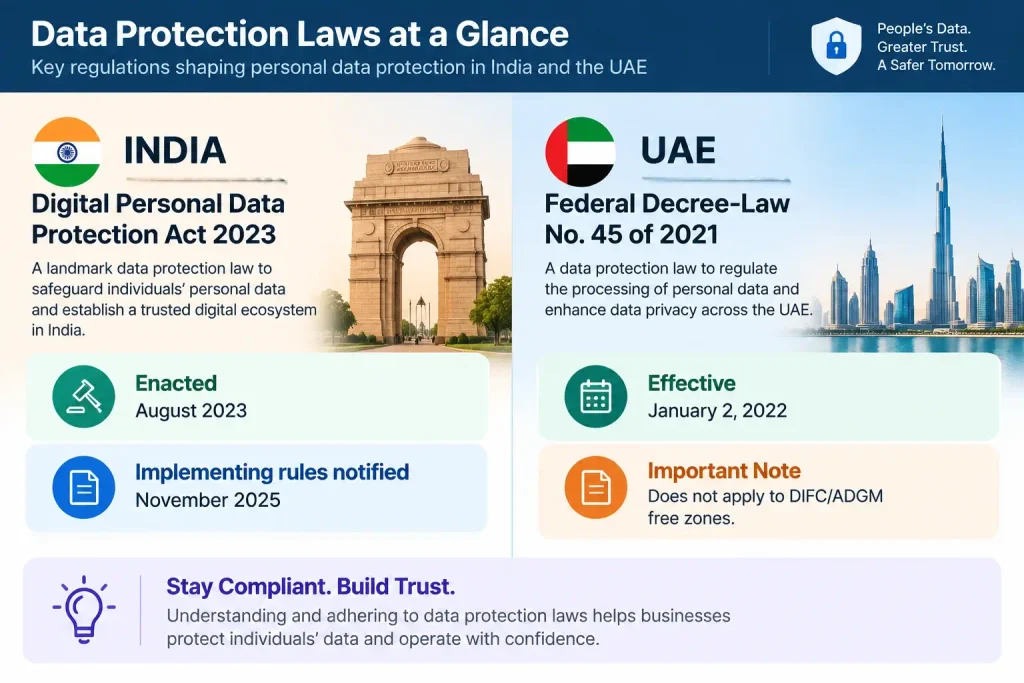
India’s Digital Personal Data Protection Act 2023 was enacted in August 2023, with implementing rules notified by the Ministry of Electronics and Information Technology in November 2025.
The UAE runs on a separate law, Federal Decree-Law No. 45 of 2021 on the Protection of Personal Data, effective January 2, 2022.
That law doesn’t apply to businesses registered in the DIFC or ADGM financial free zones, which follow their own regimes.
A retailer running WhatsApp campaigns in both markets needs a provider that can document compliance against both frameworks separately, not a single generic data protection claim.
Regional Buying Behavior
Buying behavior also differs by market, though reliable, source-attributed figures for WhatsApp penetration and COD share in the UAE and Qatar specifically are thin.
Industry consensus points to cash-on-delivery remaining common in both markets, which is why authentication and utility template support matters more for India/GCC retail buyers than for retailers in markets where card payment dominates.
Treat any vendor-quoted penetration percentage as a claim to verify, not a given, unless it cites a named, dated survey.
How to Choose the Right Platform for Your Retail Business Size
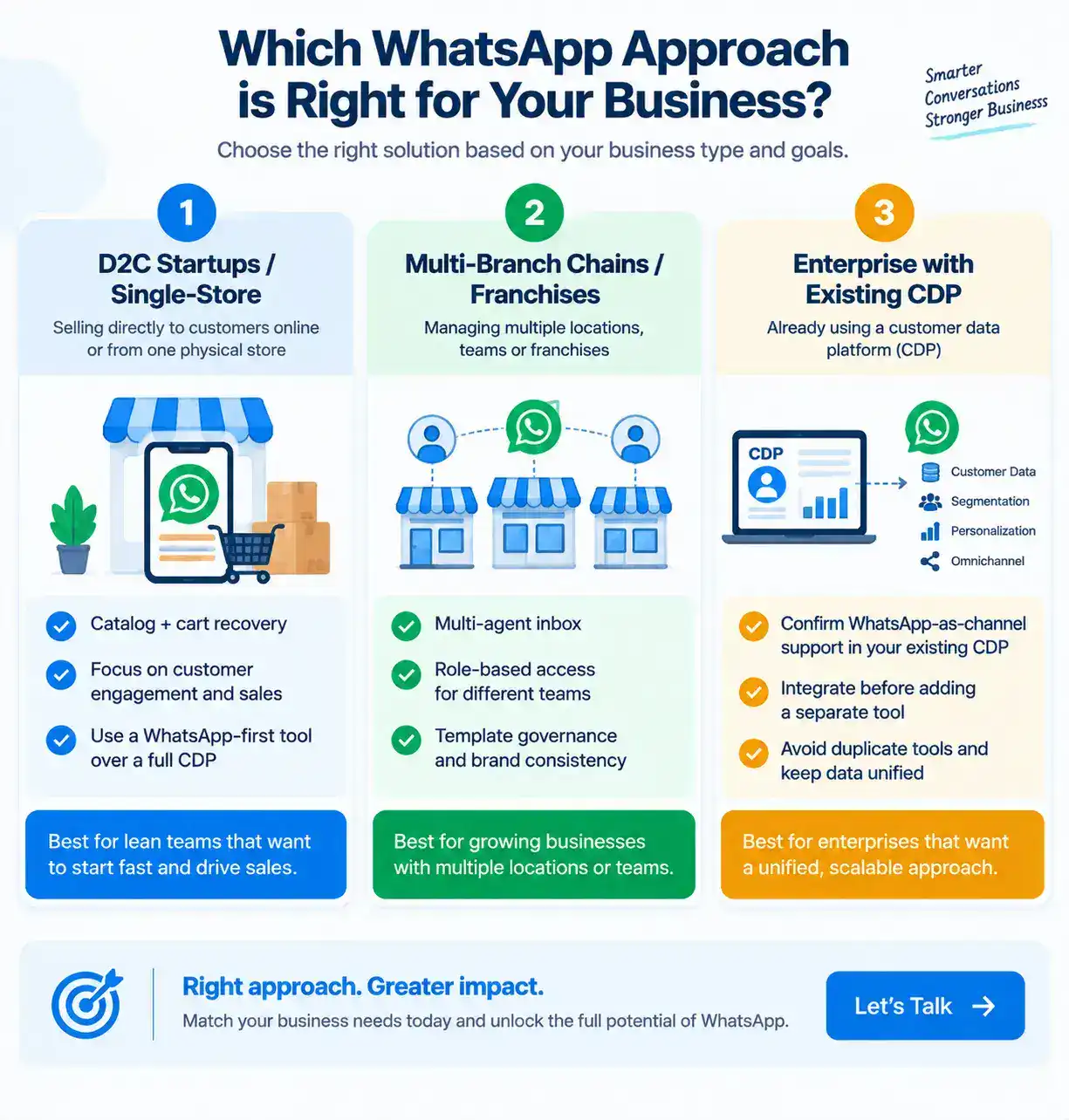
- D2C startups and single-store retailers: prioritize catalog and cart recovery features over enterprise integrations. A WhatsApp-first tool with transparent per-message markup usually fits better than a full CDP. See whatsapp business api for small businesses for a deeper breakdown of what to prioritize at this stage.
- Multi-branch retail chains and franchises: prioritize multi-agent team inboxes, role-based access, and consistent template governance across locations. Inconsistent templates across branches are a common reason Meta flags or rejects a chain’s messaging.
- Enterprise retailers already running a CDP: check whether your existing customer data platform already supports WhatsApp as a channel before adding a separate WhatsApp-only tool. Duplicate systems create reconciliation problems in reporting and double the places a template can drift out of sync with what Meta has approved.
Conclusion
The best WhatsApp Business Platform for retail in 2026 isn’t the one with the longest feature list.
It’s the one that matches your actual message mix, utility-heavy for order and shipping updates, marketing-light for promotions- against Meta’s per-message pricing, including the October 1, 2026 change to service messages and in-window utility templates.
It should also document compliance separately for India’s DPDP Act and the UAE’s Federal Decree-Law No. 45 where relevant.
WhatsApp-first platforms fit most mid-market India and GCC retailers better than enterprise customer engagement platforms built for global omnichannel programs.
Before committing to any provider, confirm their exact markup by message category and their BSP status directly.
Then ask specifically how they plan to handle the October 1 billing change on your account.
If you want a platform recommendation based on your own order volume and message mix, Intigate Technologies can walk through the comparison with your numbers, including your exposure to the October 1 pricing shift.
Frequently Asked Questions
What is a WhatsApp retail engagement platform?
A WhatsApp retail engagement platform is a WhatsApp Business API provider that adds retail-specific features on top of Meta’s platform, such as product catalogs, abandoned cart recovery, order notifications, and cash-on-delivery verification, rather than only broadcast messaging.
Is the WhatsApp Business API free for retail businesses?
No, and it’s getting less free. Meta has charged retailers per delivered template message since July 1, 2025, with rates varying by category and country. Utility templates and service messages sent inside an open customer service window have been free, but that changes on October 1, 2026, when both become billable, with a 1,000 free service message allowance per phone number per month.
Which WhatsApp platform is best for e-commerce in India?
India-focused platforms such as Interakt, AiSensy, and WATI are commonly used by D2C brands for cart recovery and catalog messaging, while retailers wanting one provider across India and the GCC often work with a regional BSP like Intigate Technologies.
Do I need a Business Solution Provider (BSP) to use WhatsApp catalog features?
Yes. For automated catalog messaging at scale, you need access through a confirmed Meta BSP. The free WhatsApp Business App supports a basic catalog, but automated triggers and bulk catalog sends require the WhatsApp Business API.