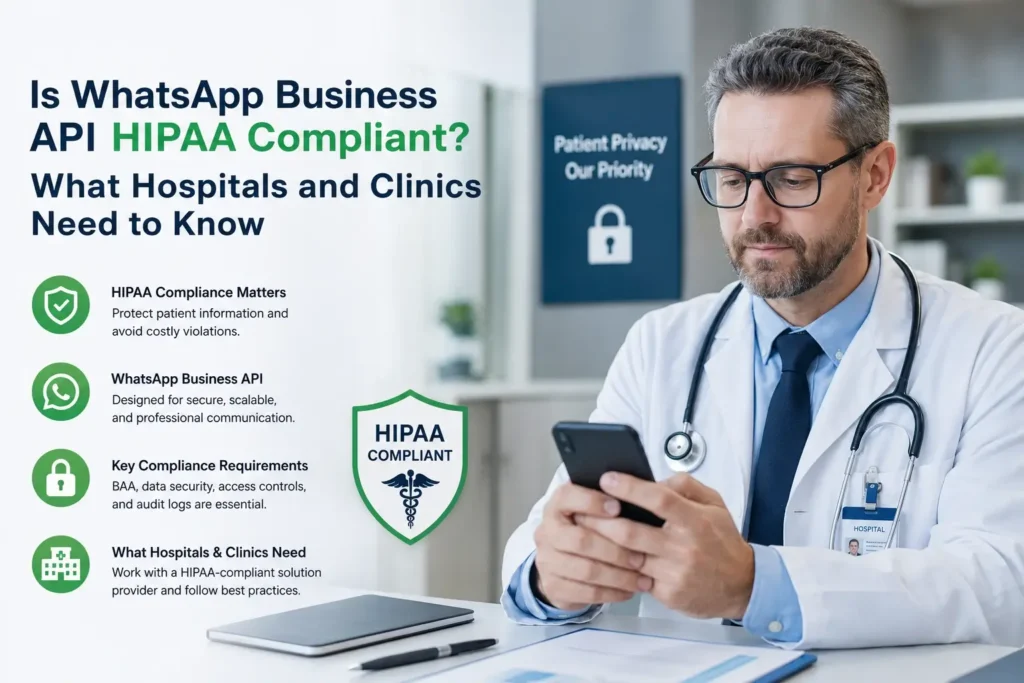
Is WhatsApp Business API HIPAA Compliant? What Hospitals and Clinics Need to Know
- WhatsApp Business API is not HIPAA compliant on its own, because Meta does not sign a Business Associate Agreement (BAA) for any WhatsApp product.
- Encryption alone does not equal compliance — HIPAA also requires audit logging, access controls, and breach notification procedures that live outside WhatsApp itself.
- Patients can request WhatsApp as a confidential communication channel under HIPAA’s §164.522(b) exception, but only if the request is properly documented.
- HIPAA violations can cost up to roughly $2.19 million per violation category, and the average healthcare data breach now costs $6.64 million to resolve.
- Hospitals can still use WhatsApp Business API safely by following a “notify and redirect” template pattern that keeps clinical detail off the platform entirely.
No, WhatsApp Business API is not HIPAA-compliant on its own — and that single fact has real consequences for the growing number of hospitals and clinics rolling out WhatsApp Business API for appointment reminders, report alerts, and patient follow-ups.
The stakes aren’t hypothetical: HIPAA penalties now reach into the millions per violation, and the average healthcare data breach costs $6.64 million to resolve.
At the same time, WhatsApp’s reach is hard to walk away from — patients open and respond to messages on the app they already check dozens of times a day far faster than a phone call or portal notification ever gets answered.
That gap between “patients respond here” and “this platform wasn’t built to carry PHI” is exactly where hospitals run into trouble, usually without realizing it until an audit or a breach forces the question.
This article covers why the default answer is no, the one legal exception that changes it, and the exact messaging pattern that lets hospitals keep using WhatsApp without putting protected health information at risk.
Which “WhatsApp” Are We Even Talking About?
Before going further, it’s worth separating three things that get lumped together in most searches on this topic, because the compliance answer is the same for all three, but the reasons — and the features — differ.
| Product | Built for | Business tooling | System integration | Meta-signed BAA available |
|---|---|---|---|---|
| WhatsApp (consumer app) | Personal messaging between individuals | None | None | No |
| WhatsApp Business app | Small businesses managing a shared inbox on one device | Business profile, quick replies, basic automation | None | No |
| WhatsApp Business API | Enterprise messaging at scale | Pre-approved message templates, verified sender identity, analytics | Connects to EMR, hospital management system, or CRM | No |
Meta’s own Business Terms of Service draw this same product distinction, and importantly, none of the three carries a different answer on HIPAA.
The API adds scale and integration, not a compliance exemption.
It’s the product most hospitals and clinics are actually evaluating when they search for HIPAA compliance, and it’s the one the rest of this article focuses on.
Quick definitions, for reference:
- BAA (Business Associate Agreement): a legal contract required under HIPAA between a covered entity and any vendor that handles PHI on its behalf, specifying safeguards and breach liability.
- PHI (Protected Health Information): any individually identifiable health information created, received, or transmitted by a covered entity — a name paired with a diagnosis, appointment type, or treatment detail all qualify.
- BSP (Business Solution Provider): a Meta-approved third party that manages a business’s WhatsApp Business API integration; this is typically where decrypted message content actually lands, not inside WhatsApp itself.
Why the Answer Is No — the BAA Problem
What a Business Associate Agreement actually requires
Under HIPAA’s Security Rule, any vendor that creates, receives, maintains, or transmits PHI on behalf of a covered entity (a hospital, clinic, or health plan) must sign a Business Associate Agreement before that PHI ever touches their systems.
A BAA is a legal contract — it spells out how the vendor will safeguard PHI, how it will respond to a breach, and what liability it accepts if something goes wrong.
It’s not a formality; it’s the mechanism that makes a third-party platform legally usable for health information in the first place.
Why Meta won’t sign one for WhatsApp products
Meta has been consistent on this point: its Cloud API Hosting Terms and WhatsApp Business Terms state that Meta does not act as a Business Associate, and that its Business Services make no representations of meeting the needs of entities with heightened confidentiality requirements — healthcare being the explicit example given.
Without a signed BAA, there is no configuration, upgrade, or workaround that makes WhatsApp Business API HIPAA compliant for handling PHI.
Third-party WhatsApp solution providers built on top of the API don’t change this either; if the message still routes through WhatsApp’s infrastructure, the missing BAA is still missing.
A pattern worth naming here, common across real deployments rather than any single incident: the violation risk rarely comes from the WhatsApp template library itself.
Templates get compliance-reviewed once, at setup, and then stay static.
The risk creeps in through the reply, a front-desk staff member fielding “so what did the results actually say?” and typing the answer directly into WhatsApp because the patient is already in the thread and it feels faster than redirecting them to a portal.
No template category or BAA discussion prevents that; only staff training and a clear “nothing clinical in a reply, ever” rule does.
That’s an operational gap, not a technical one, and it’s usually the actual point of failure.
This is also why encryption alone doesn’t resolve the question, which is worth its own section.
Encryption Isn’t the Same Thing as Compliance
What WhatsApp actually encrypts
WhatsApp uses the Signal Protocol for end-to-end encryption on personal chats, and Meta states it cannot read message content in transit.
On the Business API side specifically, the picture is a little different from the consumer app: messages sent through the Cloud API are decrypted at the business’s own system or their Business Solution Provider’s (BSP) infrastructure — that’s the point where a hospital’s team, or their WhatsApp vendor, actually sees the message.
Meta’s Cloud API also temporarily stores undelivered messages for up to 30 days to ensure delivery before they’re removed.
Where the compliance gap actually is
WhatsApp’s encryption is genuinely solid engineering; that part was never really in question.
What HIPAA compliance asks for goes further than strong encryption in transit.
The HIPAA Security Rule also calls for administrative safeguards, granular access controls, audit logging of who accessed what and when, and formal breach notification procedures — capabilities that live on the receiving system, not inside WhatsApp itself.
A hospital can encrypt a message perfectly and still be out of compliance if it can’t produce an access log when asked, or if the BSP handling that decrypted message hasn’t signed a BAA either.
Encryption protects the message. It doesn’t create the accountability chain HIPAA requires.
The One Legal Exception Most Providers Get Wrong
The patient-request exception
There’s a narrow, genuine exception here, and most competitor content mentions it in passing without explaining how to actually rely on it.
Under the HIPAA Privacy Rule (§164.522(b)), a patient has the right to request confidential communications through a specific channel of their choosing.
HHS guidance on this provision, issued originally in the context of standard email, makes clear that healthcare providers can honor such a request, including through a channel that isn’t independently HIPAA-secured, provided reasonable safeguards are applied and the request is properly documented.
In practice, this means a patient can ask to receive clinical detail over WhatsApp, and a provider can honor that request without it being an automatic violation — but only if it’s handled deliberately, not by default.
How to document it so it holds up in an audit
If your compliance program were reviewed after the fact, four things should exist for every patient using this exception:
- The date and channel of the request, ideally in the patient’s own words or a signed acknowledgment, not inferred from the fact that they replied to a WhatsApp message.
- The scope of what they consented to — general updates, or specific clinical content — since a blanket “yes” doesn’t cover everything indefinitely.
- A documented warning that WhatsApp isn’t a HIPAA-secured channel and that message content isn’t protected the way a patient portal would be.
- A periodic review point, so the exception isn’t treated as a permanent, unreviewed default two years later.
Skipping this documentation is the actual risk — not the exception itself. Regulators are generally reasonable about patient-directed choices; they are not reasonable about undocumented ones.
What’s at Stake If You Get This Wrong
It’s worth being concrete about consequences, because “compliance risk” can feel abstract until it’s a number.
2026 HIPAA penalty tiers
HHS’s Office for Civil Rights (OCR) adjusts HIPAA civil monetary penalties annually for inflation. According to HIPAA Journal’s 2026 penalty guide, current civil penalties break down across four culpability tiers:
| Tier | Culpability level | Penalty range (per violation) |
|---|---|---|
| 1 | Unknowing — organization couldn’t reasonably have known | ~$145 – $71,162 |
| 2 | Reasonable cause — knew or should have known, not willful neglect | ~$1,424 – $71,162 |
| 3 | Willful neglect, corrected within 30 days | ~$14,232 – $71,162 |
| 4 | Willful neglect, not corrected | ~$71,162 – $2,190,294 |
Criminal penalties, prosecuted separately by the Department of Justice in cases involving knowing or malicious misuse of PHI, can reach up to ten years’ imprisonment and a $250,000 fine in the most serious tier.
Because OCR adjusts these figures for inflation every year, treat this table as a snapshot to verify against HHS’s current published schedule before relying on it for a compliance decision.
The real cost — breach response, not just the fine
The regulatory fine is often the smaller number.
Per IBM’s Cost of a Data Breach Report, cited in HIPAAComplianceCost.com’s 2026 penalty guide, the average cost of a healthcare data breach, factoring in detection, notification, patient support, legal response, and reputational impact — runs to roughly $6.64 million.
Healthcare has held the highest average breach cost of any industry in IBM’s reporting for over a decade.
A misdirected WhatsApp message with clinical detail in it doesn’t automatically trigger costs at that scale, but a pattern of undocumented, unreviewed PHI exposure across a patient population is exactly the kind of finding that does.
How to Actually Use WhatsApp Without the Risk
This is the part most compliance-focused articles skip entirely, because most of them are written to steer you toward a different platform altogether.
The more useful answer for a hospital that already knows patients respond faster on WhatsApp than almost anywhere else: you can use it if you’re disciplined about what goes in the message.
The “notify and redirect” pattern
The safest and most common pattern in healthcare WhatsApp messaging is simple: the message tells the patient that something needs their attention, and directs them somewhere secure to get the actual clinical detail. It never carries the clinical content itself.
Compare these two versions of the same notification:
Not this: “Your biopsy result is ready: malignant, stage 2. Please call to discuss treatment options.”
This instead: “Hi [Name], your test results are ready. Please open your patient portal or call the clinic at [phone] to review them.”
Both get the same urgency across. Both get opened at roughly the same rate — that’s the point of using WhatsApp in the first place.
But only one of them puts PHI inside a channel that lacks a BAA.
This pattern is the backbone of most compliant healthcare WhatsApp deployments, and it applies just as well to appointment confirmations, prescription-ready notices, and follow-up reminders as it does to report alerts.
A three-question test for any message before it’s sent or templated:
- Does this message name a diagnosis, test result, medication, or treatment detail? If yes, it doesn’t belong on WhatsApp — redirect instead.
- Could this message be read over the recipient’s shoulder without exposing anything clinical? If no, rewrite it as a notification.
- Is this a reply improvised by staff rather than a pre-approved template? Improvised replies are where most real-world exposure happens — see the earlier note on reply risk — so this is the point to slow down, not the automated template.
Utility, Marketing, and Authentication templates — and why it matters
Every WhatsApp Business API template gets categorized by Meta as Utility, Marketing, or Authentication, and the category affects both deliverability and how a hospital should think about content.
Utility templates — transactional, expected messages tied to an existing interaction, like a booking confirmation or a reminder — are almost always the right category for healthcare messaging.
They’re the safest default precisely because their purpose is narrow: confirm, remind, notify, redirect.
Marketing templates invite broader promotional content and looser structure, which is exactly the kind of latitude that tempts clinical detail to creep in.
Sticking to Utility templates, built around the notify-and-redirect pattern, keeps both your Meta account health and your compliance posture in a good place at the same time.
This is the operational discipline that separates a WhatsApp deployment that quietly works for years from one that ends up in an incident report — and it’s a pattern that has to be built into the template library from day one, not patched in after something goes wrong.
Hospitals that get this right typically have a WhatsApp setup built around this pattern from the start, with every template pre-screened against a simple test: could this message be read over someone’s shoulder without exposing anything clinical?
Beyond HIPAA — DPDP, GDPR, and GCC Health Data Rules
HIPAA is the most-searched compliance benchmark globally, but it only governs US covered entities.
If your hospital operates in — or serves patients from — India, the EU, or the Gulf, other frameworks apply, and they don’t always work the same way:
| Jurisdiction | Governing rule | Consent standard | Notable constraint |
|---|---|---|---|
| United States | HIPAA Privacy & Security Rules | BAA required for any vendor handling PHI | No BAA available from Meta for any WhatsApp product |
| European Union | GDPR Article 9 (special category data) | Explicit, specific consent or healthcare-provision exception | Requires both an Article 6 lawful basis and an Article 9 condition |
| India | DPDP Act 2023 + Rules (phased through May 2027) | Free, specific, informed, unambiguous consent (risk-based, not a fixed “sensitive data” category) | Rules still phasing in — confirm current requirements with counsel |
| UAE | Federal Law No. 2 of 2019 (Health Data Law) | Patient consent before third-party disclosure | Health data generally can’t leave the UAE without specific authorization |
The detail behind each row matters more than the summary, so here’s the full picture jurisdiction by jurisdiction.
India’s DPDP Act
India’s Digital Personal Data Protection Act, 2023, along with its Rules notified by MeitY in November 2025, is still being phased in — full consent, notice, and security provisions become effective through May 2027.
Unlike the older SPDI Rules it replaces, the DPDP Act doesn’t carve out a formally separate “sensitive personal data” category; instead, it takes a broadly applicable, risk-based approach to all personal data, with heightened obligations tied to how much harm could result from misuse.
In practice, most legal guidance on the Act still treats health data as requiring the highest level of care: consent that is free, specific, informed, and unambiguous, clear purpose limitation, and documented breach notification — because the potential for harm from mishandled health data is high regardless of its formal statutory label.
Because the Rules are still in a phased rollout, hospitals operating in India should confirm current consent-form requirements with local counsel rather than relying on a fixed checklist.
GDPR basics for hospitals messaging EU patients
If you’re messaging patients in the EU, health data falls under GDPR Article 9 as a “special category” of personal data, alongside things like biometric and genetic data.
Article 9 sets a general prohibition on processing this category unless a specific exception applies — for healthcare providers, that’s most often explicit consent (Article 9(2)(a)) or the healthcare-provision exception (Article 9(2)(h)), and both require a separate lawful basis under Article 6 on top of the Article 9 condition.
Explicit consent under GDPR is a meaningfully higher bar than a checkbox: it requires a clear statement that specifically names the health data being processed and the purpose, not a bundled terms-of-service acceptance.
A WhatsApp message that simply notifies a patient something is ready and redirects them elsewhere is far easier to justify under GDPR than one carrying clinical content directly.
GCC health data rules
The Gulf doesn’t have one unified rule; each jurisdiction sets its own.
The UAE’s Federal Law No. 2 of 2019 (the Health Data Law) requires patient consent before disclosing health data to third parties and — notably — restricts health data from being transferred, processed, or stored outside the UAE without specific authorization, which has direct implications for where a WhatsApp vendor’s infrastructure and BSP actually sit.
Qatar and Kuwait maintain their own health data and data protection frameworks with different consent and cross-border requirements.
Because these rules vary by emirate, free zone, and country, and because enforcement details change, hospitals in the GCC should validate specific consent and data-residency requirements against their operating license rather than assuming one Gulf country’s rule applies across the region.
What to Look For in a Compliant WhatsApp Setup
Whether you build this in-house or work with a WhatsApp Business Solution Provider, the same questions apply regardless of vendor:
- Does the vendor sign their own agreements covering PHI handling on their side of the integration, separate from the (non-existent) BAA from Meta?
- What’s their default template category for patient-facing messages, and do they push Utility-first, notify-and-redirect templates as the standard — or do they leave content decisions entirely up to you?
- Where does decrypted message data live, and for how long, once it leaves WhatsApp’s infrastructure and reaches their systems?
- Can they produce an access log showing who on your staff (or theirs) viewed a given conversation, and when?
- Do they understand the jurisdiction you actually operate in — HIPAA, DPDP, GDPR, or GCC health data rules — rather than defaulting to a US-only compliance pitch?
- What happens when Meta pauses a template or account — automated enforcement affects every WhatsApp Business API user eventually, and a vendor’s response plan for that moment matters as much as their compliance posture on a good day.
These are vendor-neutral questions worth asking anyone you’re evaluating.
If it’s useful context, this is what we walk hospitals through before onboarding at Intigate, not because every hospital needs our specific setup, but because the underlying questions above are the ones that actually predict whether a WhatsApp rollout holds up a year in.
Frequently Asked Questions
Is WhatsApp Business API HIPAA compliant?
No, not on its own. Meta does not sign a Business Associate Agreement for any WhatsApp product, and a BAA is required before PHI can legally move through a platform. WhatsApp Business API works well for appointment logistics and non-clinical updates, but clinical detail should stay off the channel by default.
Can I text patients on WhatsApp if they ask me to?
Yes, within limits. HIPAA’s Privacy Rule (§164.522(b)) lets patients request confidential communication through a channel of their choosing, including one that isn’t independently HIPAA-secured. To rely on this safely, document the date of the request, what the patient consented to, a warning that WhatsApp isn’t a secured channel, and review it periodically.
Does WhatsApp Business API offer a BAA?
No. Meta’s Business Terms explicitly state it does not represent that its Business Services meet the needs of entities with heightened confidentiality requirements, healthcare included, and it does not sign BAAs for any WhatsApp product — consumer app, Business app, or Business API.
Is WhatsApp GDPR compliant for EU patients?
It can be used compliantly, but health data falls under GDPR Article 9 as special category data, requiring both a lawful basis under Article 6 and a specific Article 9 condition — usually explicit consent or the healthcare-provision exception. Notification-style messages that redirect patients elsewhere for clinical detail are far easier to justify than messages carrying health content directly.
What’s the difference between WhatsApp and WhatsApp Business API for compliance purposes?
None, functionally. WhatsApp, WhatsApp Business app, and WhatsApp Business API all lack a Meta-signed BAA, so the core compliance answer is identical across all three. The Business API adds scale, template management, and system integration — useful operational features, but not a compliance exemption.