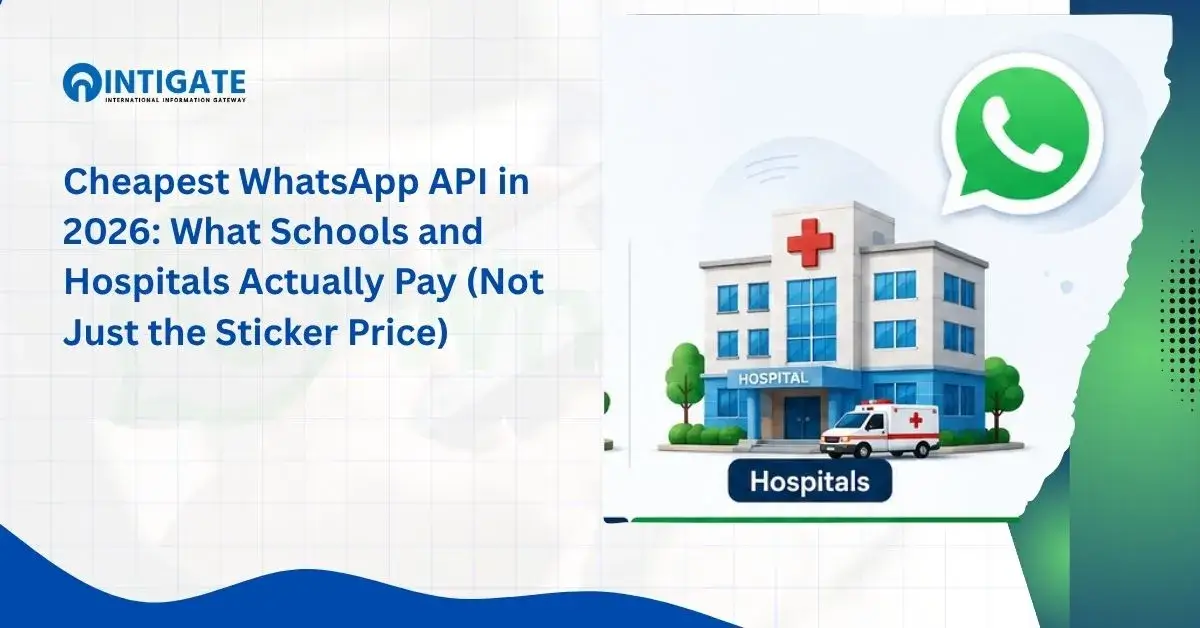
Cheapest WhatsApp API in 2026: What Schools and Hospitals Actually Pay (Not Just the Sticker Price)
- The cheapest WhatsApp API is not the platform with the lowest subscription fee. It is the provider with the lowest combined cost of the platform fee, Meta’s per-message rate, and any setup charge.
- As of October 1, 2026, Meta charges for WhatsApp service messages, the free-form replies sent inside the 24-hour customer service window. Each business phone number gets 1,000 free service messages a month before billing starts.
- Some of the cheapest options by sticker price connect through unofficial gateways instead of Meta’s official WhatsApp Business Platform. This can get a business number permanently banned, with no appeal process.
- A school sending fee reminders and a hospital sending appointment confirmations have different cost profiles. Marketing and utility category messages are billed at different rates, and marketing never receives a volume discount.
- Under India’s Digital Personal Data Protection Act, 2023, choosing a WhatsApp API provider for student or patient data is a compliance decision as well as a pricing decision (Ministry of Electronics and Information Technology, Government of India, 2023).
The cheapest WhatsApp API is rarely the provider advertising the lowest monthly fee on its homepage.
Meta charges separately for every message a business sends, and that per-message rate usually decides the real bill, not the subscription price.
If you run a school or a hospital and you are comparing business whatsapp api price pages side by side, you are likely comparing subscription tiers that hide the two costs that matter most: Meta’s own message rate and whatever margin the provider adds on top of it.
Since October 1, 2026, that comparison has gotten more complicated.
Meta now bills the category of message that was free since November 2024: service replies inside the open customer window, once a business exceeds 1,000 of them a month per number.
Any “cheapest WhatsApp API” list published before September 2026 does not reflect this.
This article breaks down what a WhatsApp API actually costs a school sending fee reminders and a hospital sending appointment confirmations, using currently published rates, and it names the compliance risk that some low-price providers do not disclose.
Get a quote that separates Meta’s message rate from the platform fee, so you know exactly what you are paying for and why.
Get a Transparent Quote →WhatsApp Business App vs. WhatsApp Business Platform (API): Which One Are You Actually Comparing?
WhatsApp Business App: A free mobile app for small businesses to message customers manually from a single device. It has no per-message fee and no automation beyond basic quick replies.
WhatsApp Business Platform (API): Meta’s paid, developer-level infrastructure for sending messages at scale through an approved provider, with per-message billing and multi-agent, multi-device access.
If your school or hospital sends fewer than a few hundred messages a month from one phone, the free Business App may cover you at zero Meta cost.
Every price discussed in this article applies only once you need the API: broadcast sending, integration with a student information system or hospital EHR, or more than one staff member replying from the same number.
Confusing the two is the single most common reason a “cheapest WhatsApp API” search leads to the wrong purchase.
Why “Cheapest” Isn’t One Number: The Three Costs That Make Up Your WhatsApp API Bill
WhatsApp Business Platform: Meta’s official messaging infrastructure that lets a verified business send and receive WhatsApp messages at scale through an approved provider.
Every WhatsApp API bill is made of three separate charges, and providers rarely show all three on the same page.
- Meta’s per-message rate. Paid to Meta, based on the message category and the recipient’s country.
- The provider’s platform or subscription fee. The flat monthly amount charged by whichever company you sign up with.
- A one-time setup or verification cost. Meta Business Verification support, template-writing help, or an activation fee some providers charge.
A provider with a low subscription fee and a hidden margin on Meta’s rate can end up costing more per month than a provider with a slightly higher subscription and no margin at all.
Meta’s Official Message Categories and Rates
Template message: A pre-approved message format required whenever a business starts a conversation with a customer outside an active 24-hour service window.
Meta bills five message categories on the WhatsApp Business Platform as of October 2026: Marketing, Utility, Authentication, Service, and Meta Business Agent (Meta, WhatsApp Business Platform Pricing documentation).
Utility and authentication rates unlock volume discounts as your monthly message count grows, a mechanic Meta calls tiering.
Marketing and service messages do not get this discount, regardless of volume.
As one concrete data point, AiSensy’s published India rate, which follows Meta’s own per-message pricing model, lists marketing messages at ₹1.09 and utility or authentication messages at ₹0.145 each.
That gap, roughly 7.5 times more per message for marketing than for utility or authentication, is the single biggest reason a school and a hospital can pay very different amounts for what looks like the same “cheapest WhatsApp API.”
The Provider Markup on Top of Meta’s Rate
Some providers pass Meta’s rate through with no added charge.
AiSensy states that it does not add a markup on Meta’s conversation rates and charges only its own platform fee separately.
Other providers build a margin into their per-message price instead of billing Meta’s rate as a separate line item.
Industry pricing comparisons put typical Business Solution Provider markups anywhere from zero, a flat platform fee with messages passed through at cost, up to roughly 30 to 60 percent over Meta’s wholesale per-message rate.
Ask any provider you shortlist to show Meta’s rate and their own margin as two separate numbers before you sign, rather than trusting a single blended figure.
The Change Nobody’s Old Pricing Page Mentions: Meta’s October 1, 2026 Service Message Charges
Service messages, free-form replies sent inside an open 24-hour customer service window, were free from November 2024 through September 2026. That changed on October 1, 2026.
Meta now bills service messages at the same rate as utility and authentication messages for the recipient’s country, but each business phone number gets 1,000 free service messages per month before billing starts.
The free quota resets monthly, does not carry over unused messages, and applies separately to each number, not pooled across a business’s whole account.
Utility templates sent inside that same window lost their free status on the same date.
For a sense of scale: a business sending 10,000 service messages a month to users in the UAE, where the service rate matches the utility/authentication rate of $0.0157, pays (10,000 − 1,000 free) × $0.0157, or roughly $141 a month in service message charges alone, on top of anything it already spent on templates.
A school or hospital with lower reply volume may stay inside the free 1,000-message quota entirely; one running a busy support inbox on a single number likely will not.
The same October 2026 update raised marketing rates in several markets, including Kuwait, Morocco, Mexico, Saudi Arabia, the UAE, and the broader “Other Middle East” and “Other Asia Pacific” rate groups, while utility and authentication rates rose in eight markets and fell in four, including notable cuts in Sri Lanka, Nepal, and Bangladesh.
If your organization messages users outside India, check your specific recipient countries against the current rate card rather than assuming last year’s number still applies.
A separate change lands earlier in the calendar. From August 1, 2026, replies generated through Meta’s own AI feature, Meta Business Agent, are billed by token rather than as a per-message charge, at $2.00 per million tokens globally.
A typical reply consumes roughly 20,000 to 25,000 tokens, which works out to about 4 to 5 cents per reply.
This applies only when Meta’s own AI generates the reply; a human agent or a third-party chatbot answering the same message is billed as an ordinary service message instead.
If a “cheapest WhatsApp API” comparison you are reading does not mention the 1,000-message service quota or the token-based Meta Business Agent rate, it was written before mid-2026, and its numbers no longer reflect what you will actually pay.
Official Meta Business Solution Provider vs. Unofficial WhatsApp Gateway: Why the Cheapest Number Can Be the Most Expensive Mistake
Business Solution Provider (BSP): A company Meta has formally approved to give businesses access to the official WhatsApp Business Platform, as distinct from a company that connects to WhatsApp through an unapproved method.
Two of the lowest-priced tools reviewed for this article connect differently than the official platform does.
WASenderApi describes itself, in its own product listing, as a service that does not require Meta’s approval and positions itself as an alternative to the official WhatsApp Business API.
GREEN-API’s core product lists a QR-linked, phone-free operation style feature and markets a separate, distinctly named “GREEN-API: WABA” product for the official WhatsApp Business Account, which suggests its base product is not the same thing.
This distinction matters because WhatsApp’s own business policies do not permit unapproved automation methods, and a number connected this way can be blocked with no appeal process.
For a school mid-way through a fee collection cycle, or a hospital sending same-day appointment confirmations, losing the number is a far higher cost than any subscription fee saved.
Any WhatsApp Business API Provider you shortlist should confirm, in writing, whether it operates on Meta’s official Cloud API or an unofficial gateway before you migrate a single template.
What “Cheapest” Actually Costs a School: Fee Reminders, Attendance Alerts, and Admission Broadcasts
In a whatsapp business api for education deployment, most messages fall into two categories.
Broadcast fee reminders and admission announcements sent to all parents are in the Marketing category.
Individual attendance alerts and confirmations are in the Utility category.
Marketing carries the highest per-message rate of the categories and never receives a volume discount, while Utility can unlock lower rates at higher volumes.
Illustrative example (India rates): A school with 500 enrolled families sending one weekly fee or event broadcast (Marketing) and one weekly attendance alert (Utility) to each family sends roughly 4 marketing and 4 utility messages per family per month.
At AiSensy’s published India rate of ₹1.09 per marketing message and ₹0.145 per utility message, that works out to (4 × ₹1.09) + (4 × ₹0.145) = ₹4.94 per family per month, or approximately ₹2,470 per month in Meta message charges alone across 500 families, before any platform fee.
If office staff also field parent questions by replying directly (a service message), that traffic is likely to stay inside the new 1,000-free-message monthly quota for most schools of this size, but a school running a larger, multi-staff support line on one number should track it.
Schools outside India should confirm the equivalent marketing and utility rates for their own country on Meta’s published rate card, since rates vary significantly by region.
What “Cheapest” Actually Costs a Hospital: Appointment Reminders, OTPs, and Patient Follow-Ups
A hospital’s message mix looks different. Appointment confirmations and reminders are Utility category, billed lower than Marketing and eligible for volume discounts.
OTPs for patient portal logins are Authentication category.
Because hospitals often reply to patients who message first, a larger share of hospital traffic falls inside the 24-hour service window, which is exactly the traffic now affected by the October 1, 2026 change.
Illustrative example (India rates): A hospital sending 800 appointment reminders (Utility) and 200 OTP logins (Authentication) a month, at ₹0.145 per message for both categories, pays roughly ₹145 per month in Meta template charges, a fraction of the school example above, because none of this traffic is Marketing category.
On top of that, a hospital fielding patient questions by direct reply now needs to budget for service messages beyond the first 1,000 per number each month; a busy single-number front desk can cross that threshold well before month’s end.
For a fuller comparison of WhatsApp against SMS for clinical and appointment workflows, see WhatsApp Business API vs SMS for Healthcare.
Patient data adds a compliance layer that most schools do not carry in the same way.
Under India’s Digital Personal Data Protection Act, 2023, a hospital processing patient data digitally is a Data Fiduciary with direct obligations around consent, breach notification, and data minimisation.
Before selecting the cheapest provider, confirm where patient message logs and templates are stored and for how long.
How to Verify a Provider Is an Official Meta Business Solution Provider
- Ask the provider directly whether they are a Meta Business Solution Provider or a Tech Provider, and ask for their Meta partner listing.
- Confirm the platform requires a dedicated business phone number and completed Meta Business Verification. This step only exists on the official WhatsApp Business Platform.
- Watch for language about “linking your WhatsApp account” or scanning a QR code from your personal WhatsApp. This is a sign of an unofficial gateway, not the official Cloud API.
- Ask to see their listing among Meta’s Business Solution Providers, or search for the company name alongside “Meta Business Solution Provider” before signing a contract.
Conclusion
The cheapest WhatsApp API is the one with the lowest combined total of Meta’s per-message rate, the provider’s platform fee, and any setup cost, not the one with the smallest number on its pricing page.
That combined total shifted for every provider on the market on October 1, 2026, when Meta began charging for service messages beyond a 1,000-per-number monthly quota.
For a school, most of the cost still sits in Marketing-category broadcasts.
For a hospital, most of it sits in lower-cost Utility and Authentication messages, plus a new line item for service replies once volume grows, alongside a real compliance obligation under India’s DPDP Act if the data involves patients.
Before you commit to any provider, confirm its Meta Business Solution Provider status in writing and ask it to show Meta’s rate and its own fee as two separate numbers.
Frequently Asked Questions
What is the cheapest way to use WhatsApp API?
Add up three numbers before comparing providers: Meta’s per-message rate for your country and message category, the provider’s platform fee, and any setup cost. A low subscription fee with a hidden markup on Meta’s rate is often more expensive than a transparent, slightly higher subscription with no markup.
Are service messages still free on WhatsApp after October 2026?
Partly. Since October 1, 2026, each WhatsApp business phone number gets 1,000 free service messages a month. Once you go over that, every additional service message is billed at your country’s utility/authentication rate, with no volume discount and no rollover of unused free messages.
Why is WhatsApp API so expensive in 2026?
Costs are rising because Meta charges per delivered message rather than per 24-hour conversation, and since October 1, 2026, it also charges for service messages and in-window utility templates that were previously free, beyond a monthly free quota. Marketing messages carry the highest rate and never receive a volume discount, which raises costs further for broadcast-heavy senders like schools.
Can schools or hospitals get WhatsApp Business API for free?
Some providers, including AiSensy, offer a free platform tier, but Meta’s own per-message charges still apply once you send template messages beyond any included credit, and service messages beyond the 1,000-per-number monthly quota are billed too. There is no way to use WhatsApp Business API at true zero cost once your message volume grows past a small free allowance.